
Loading cart contents...
NYFF63: An Interview with Alexandre Koberidze
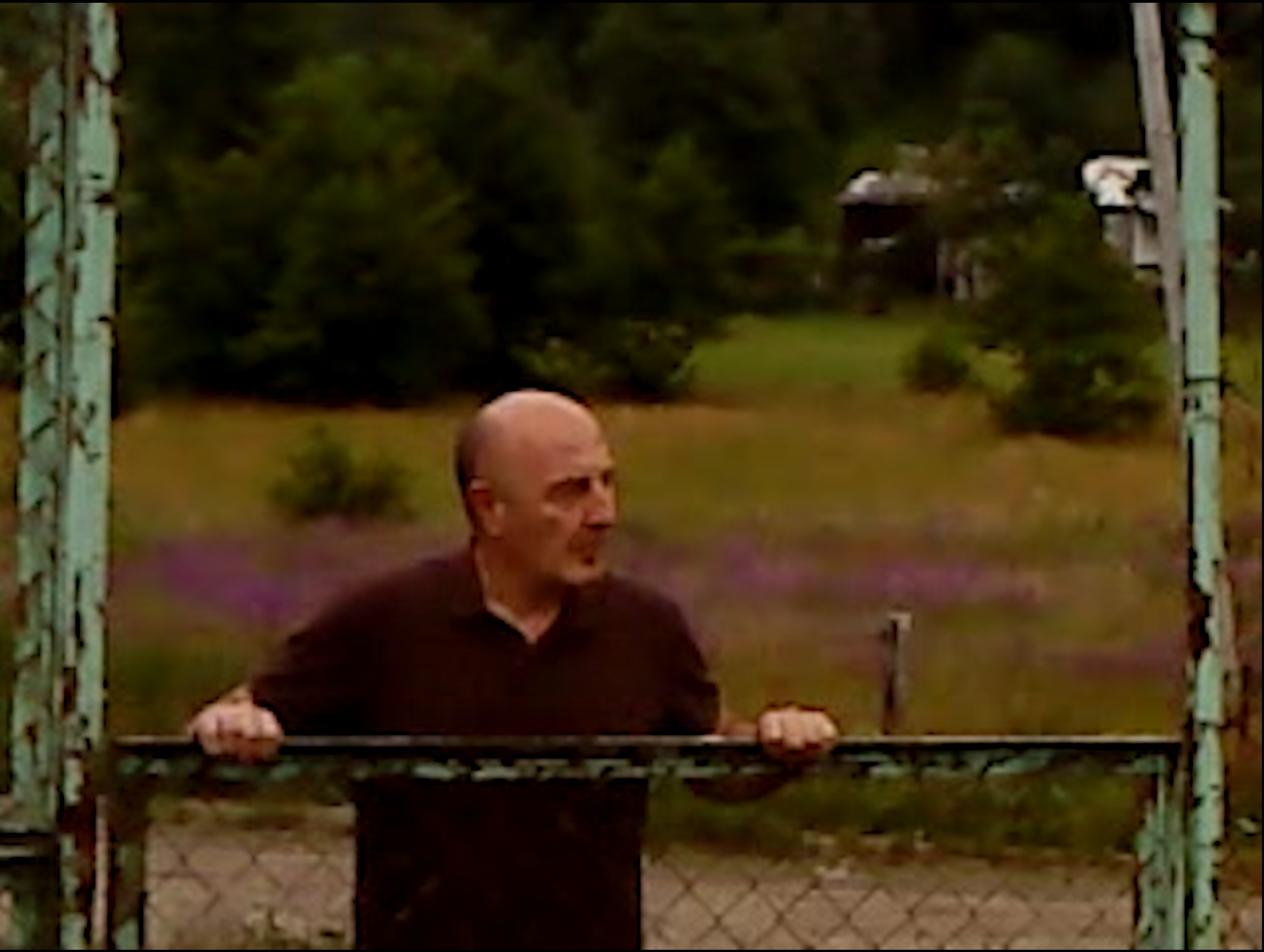
Image courtesy of @New Matter Films
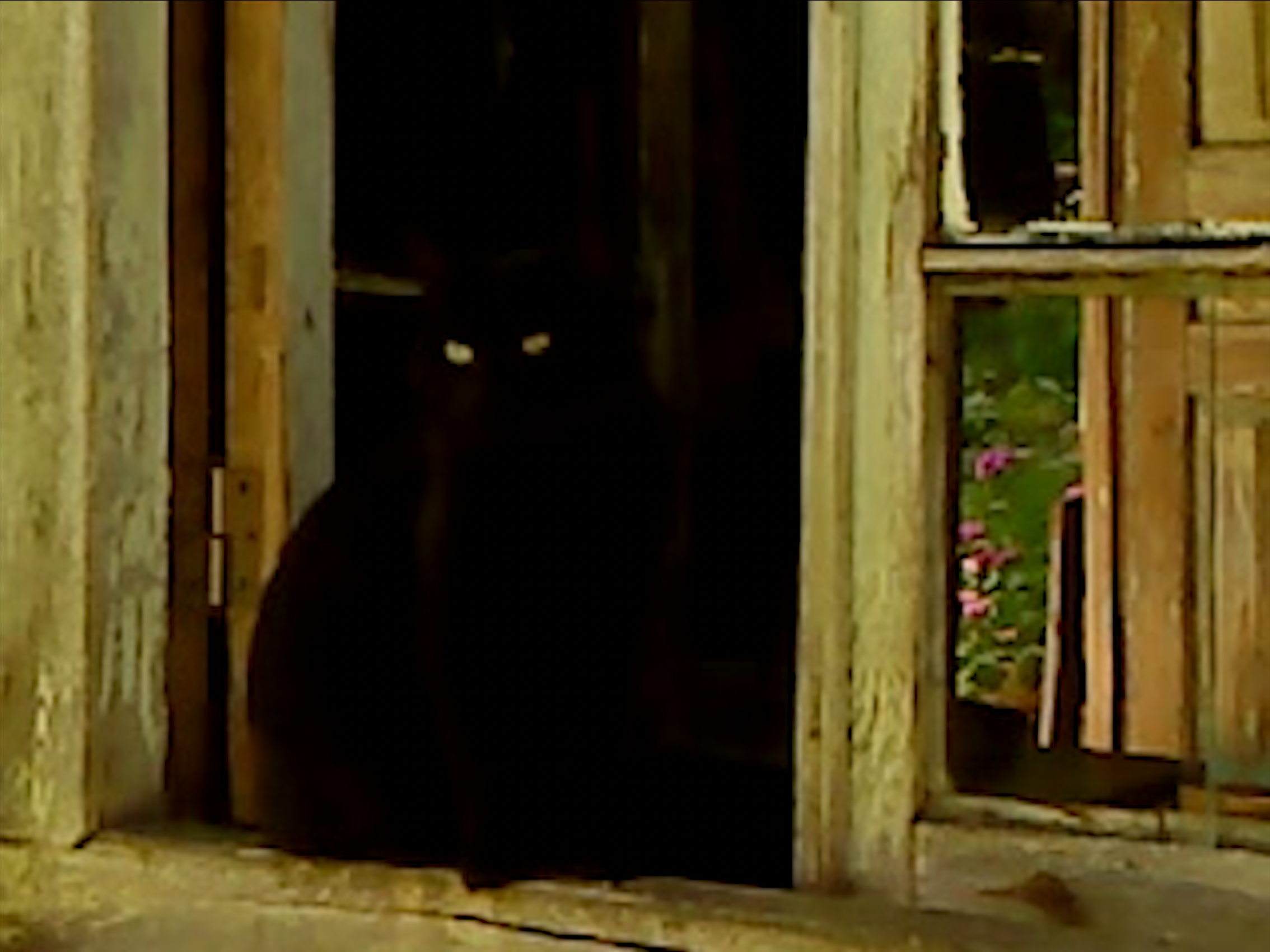
Filmed entirely on an old cell phone (Sony Ericsson W595), Alexandre Koberidze’s new feature Dry Leaf is a tender (and low resolution) contemplation on a disappearance. Scored by Koberidze’s brother Giorgi, the film kicks off with an upbeat montage of endearing snapshots of city life: stray dogs and cats, fallen leaves floating close to the ground, wind flipping through pages of old books at a flea market. Although these opening shots suggest an urban setting, the film soon shifts gears into a road movie in Georgia’s countryside.
Irakli and his wife, Nino, receive a letter from their only daughter, Lisa, a photojournalist who has suddenly disappeared. Lisa had been traveling with her colleague Levan, who was covering the same football fields assignment for their sports magazine. Levan, who had originally traveled alongside Lisa, now joins Irakli in retracing her steps. In each town, Irakli walks onto the football fields, shows Lisa’s photograph, and asks the children if they’ve seen her — but no one recognizes her.
Viewers are drawn in early as an unseen narrator explains that while some characters are present in the frame, we won’t actually see them on screen. This device immediately shapes how we experience the film: certain figures, including Levan, remain invisible, suggested only in words and gestures around them. In their absence, Koberidze reveals how cinema can conjure presence without ever showing it..
Dry Leaf is Koberidze’s third feature, following What Do We See When We Look at the Sky? (2021) and Let the Summer Never Come Again (2017). Dry Leaf made its North American premiere as part of this year’s NYFF Currents lineup.
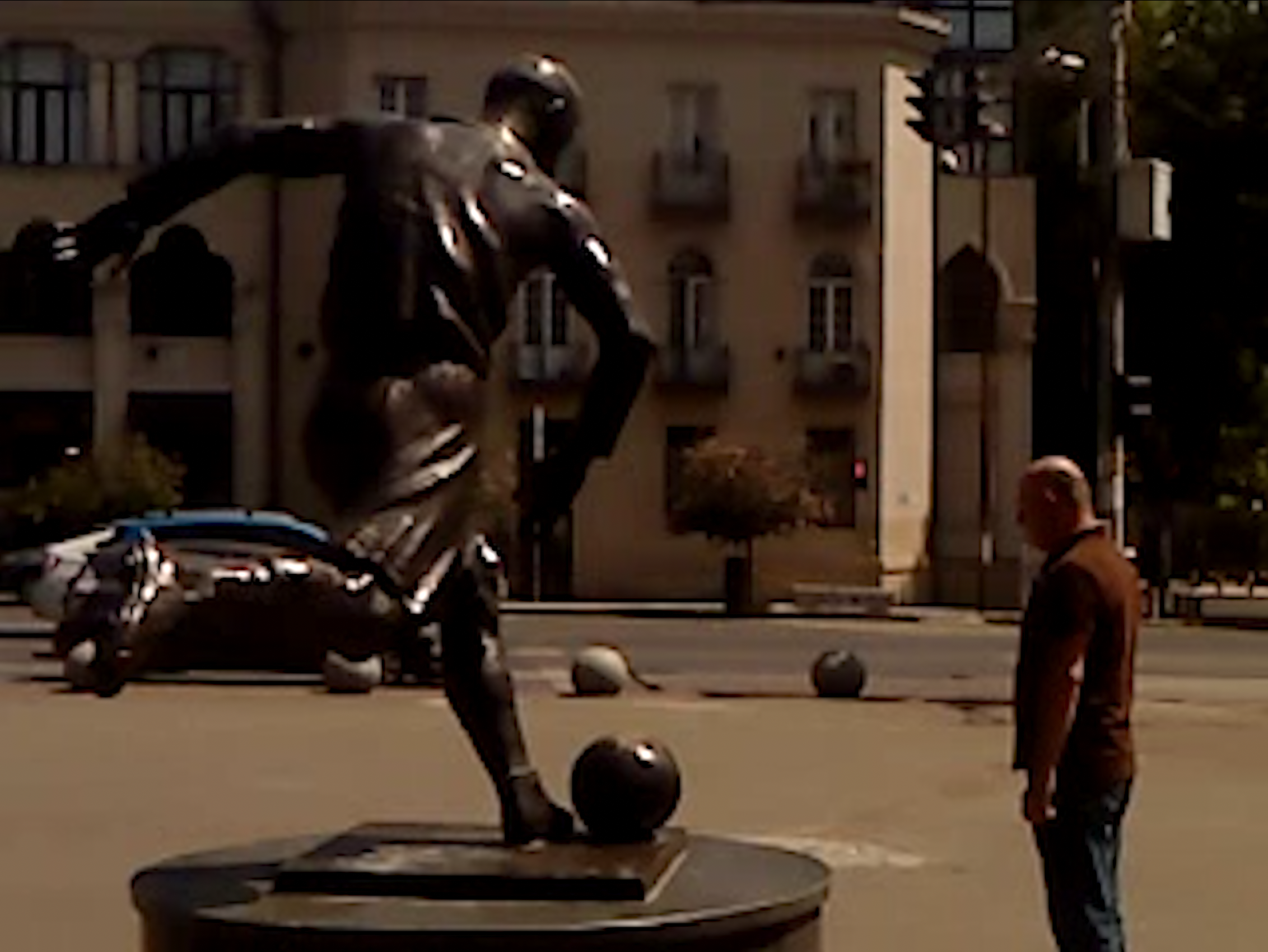
Matilda Hague: There’s a moment towards the end of the film where we’re in Lisa’s boss’ office. On the desk, there’s a photo of Messi, blurred by a glass bottle. The bottle is then picked up and used to water the plants. In a way, this encapsulates the major themes you explore in the film: football, nature, and absence. Do you feel that football is a starting point for you, or something that just finds its way into your work?
Alexandre Koberidze: Well, first of all, it’s actually Maradona on the postcard. It’s hard to tell because the image is blurred and zoomed in. I bought it in Buenos Aires before the World Cup final in 2022. I wanted it as a present for some friends, and also for myself. What surprised me was that it was impossible to find a postcard of Messi. When I asked the vendor, she said he still needed to prove himself. Two days later, of course, it was clear he had.
For me, football is a way to stay passionate about filmmaking. For example, I really struggle with early mornings. During shoots, when we have to be somewhere at seven for the light, it always feels like torture. I wake up thinking, “Why did I start all this? I can’t.” But after ten minutes, I drink some water, and I can go on with the day. With football, it’s different. If I’m going to play with my friends at seven, I’m already up at six and can’t wait to get there. It’s maybe the only thing that makes me wake up without any issue. And if you have something like this in your life, of course, as you said, on the one hand it sneaks its way into what you do. But then at some point I thought, since it’s already sneaking in, why not just open the door and let it in?
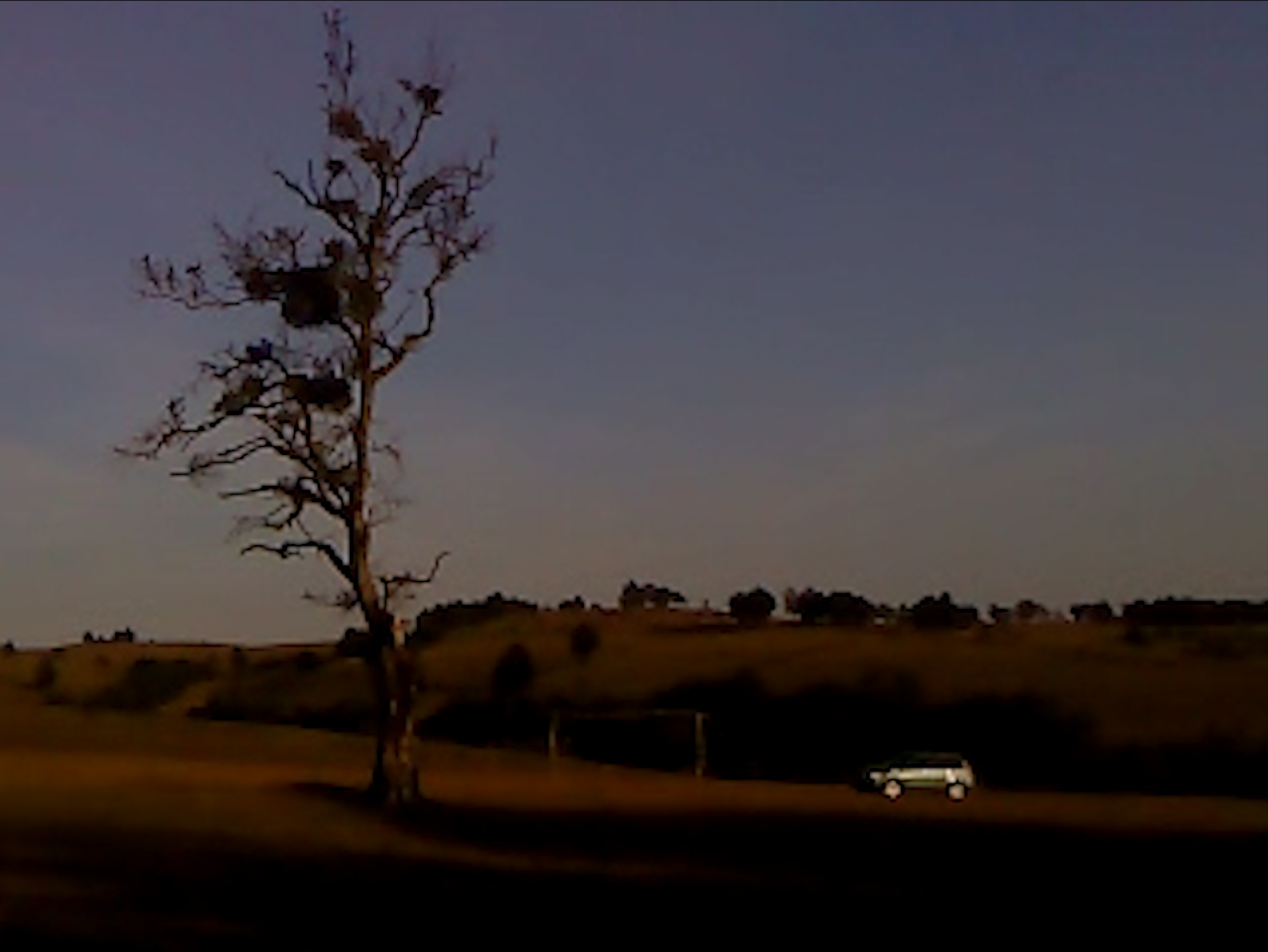
MH: The film ends with Irakli’s bedtime thoughts: “How wonderful it is, right, that there are roads.” I’m curious what made you want to make a road movie? Especially since your last film was so urban (What Do We See When We Look at the Sky?), what made you decide to hit the road?
AK: My previous film (Let the Summer Never Come Again) was also very urban — even more than What Do We See…. With that one, I had planned not to make a kind of city portrait, but it still went in that direction, because my interest in cities kept sneaking in. I didn’t want to repeat myself, so I thought if I stayed in a city again, it would happen once more. When I filmed in Tbilisi in 2014 and 2015, I shot so much that, by the end, I was really done with it. Now I feel ready to return, but I knew that if I started a film here, it would inevitably become another “city film.” So with Dry Leaf, I wanted to leave that behind by simply going away. But not only that — I also wanted to make a film with as little planning as possible.
Traveling each day, seeing new places, makes it impossible to plan or storyboard in advance. It didn’t really feel like a road movie, more like a boat movie, floating along. That reminded me of a short we made in 2014, Colophon, where we traveled by boat — and I remembered how much I liked that. This time I was curious to see the country anew, to discover places for the first time.
MH: Thinking about the title Dry Leaf, and aesthetically speaking, the film is striking. Obviously because of the format you chose, but also the color scheme: its orange tones, autumn hues. It almost feels like we’re always driving into the sunset, in this eternal golden hour. Could you tell us more about the format and the aesthetic decisions in relation to the season you chose to represent?
AK: Dry Leaf refers to autumn. And I think everyone loves that light — it’s beautiful. But the problem was that I actually filmed much of the movie in summer. We were eager to start, we’d been waiting too long. In some ways this was a blessing: in summer the villages are a bit more alive, with kids around, which disappears once school begins. Even so, many places in the film are already empty, and later they become even emptier.
I also knew this camera has very few settings — basically it shifts between orange and blue, without much nuance. So while I was shooting in summer, with everything green, the sunlight would still turn it orange, which was exactly how I wanted it to look. Still, the best moments were in late September or October, when it wasn’t so hot. In summer afternoons we often had to stop filming altogether. Maybe that’s why the film gives the impression of a constant golden hour. I’ve been working with this phone since 2009, and over time I’ve noticed how unpredictable the image is. You can’t measure light the way you can with a regular camera. Each location is an experiment, and depending on the moment of the day, some shots are less interesting. That meant we were often waiting for the right conditions — sometimes even leaving a place and returning a week later, depending on the forecast and the light we could expect.
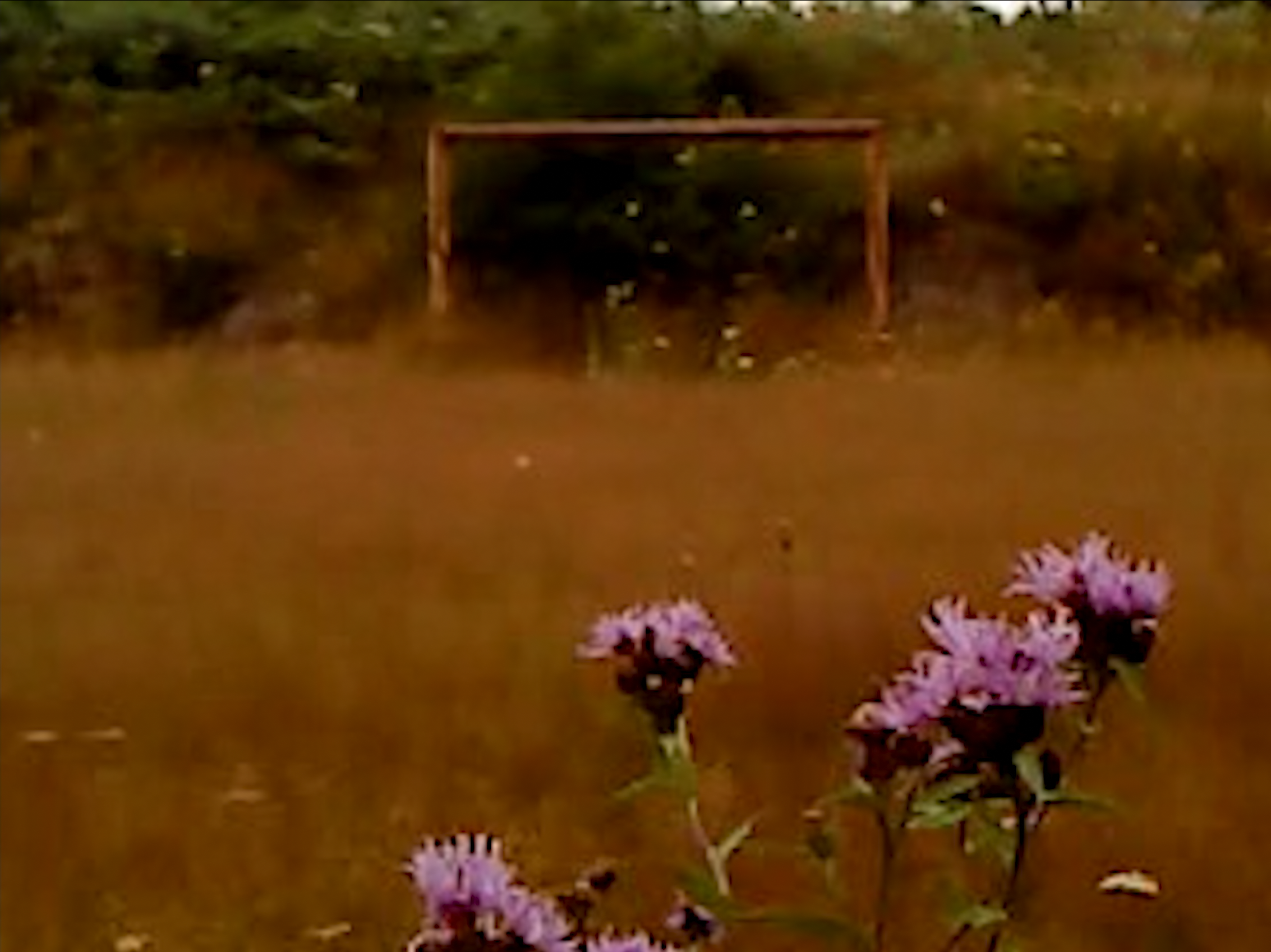
MH: I wanted to ask you more specifically about the format. I couldn’t help thinking of Hito Steyerl’s essay In Defense of the Poor Image. I was making the connection with football, too — because we’re usually obsessed with high resolution, but we seem to accept concessions when it comes to watching football. What was behind this very bold decision in terms of format?
AK: I agree. Sometimes now they use these 4K cameras in football, like to shoot corners. It doesn’t happen all the time, but when they do — when someone is about to kick, for example — it’s the worst moment. Because that’s when you really lose this fairytale aspect of football. Suddenly you start thinking: this guy is half my age, if he can kick the ball, I can too. They become real, ordinary human beings when filmed this way. I felt the same thing going to the stadium. On one hand, it has this magic of being there together, but at the same time you discover: they’re just people. From afar they look like Titans, but when you film them close up, in such high resolution, that border is crossed and the magic is gone.
When I bought this phone in 2009, I was struck by the quality of the images. The still photos especially — I really found them beautiful. Before that, I was convinced I couldn’t make good images. I knew I wanted to make films, but I thought I’d always need a cinematographer. I never took photographs, never filmed myself. Then suddenly, with this camera, I liked a picture I had made. That was a real discovery, and it was hard to let go.
I tried it with video too. Sometimes it needed more time to adjust to light, or to be framed properly, but it was possible. And it wasn’t so difficult to use — if you spent a few hours outside with it, you’d catch something nice. That was the beginning. But the more you work with it, the more interesting it gets, because it’s constantly battling with light. It has such low resolution that when it’s dark, it can’t really catch the object, so it’s always adapting, always shifting. You can’t lock exposure. It’s like this ongoing struggle between dark and light — I’m getting philosophical, but it really feels like a battle, and you experience it all the time.
And then there’s another aspect, which I wasn’t really thinking about before making the film: the way it makes the brain work. The more a camera shows you, the less your brain has to do. If everything is clear, then it’s just there. But this camera shows maybe one third of the information, and the rest is completed by your brain. Over three hours of watching, with images changing quickly, your brain is constantly working, filling in. And in that process, I think you get closer to the objects, to what you’re seeing. Because one third is the image, and two thirds is yours. So you become very connected to it.
MH: Thinking again about the title and the seasons: there’s a scene where Irakli talks with some children about the frost and its effect on the harvest. He asks them, “Did the vineyard survive? Or is it completely ruined?” Were you interested in addressing themes like climate change or agricultural labor, or did those elements just emerge naturally?
AK: Most of the dialogues, like this one, just happened. We met the kids by chance and started talking, nothing was planned. They simply shared what was on their minds. And I think it doesn’t matter whether it’s climate change or government decisions that damage nature — you don’t need to ask about it. If you go there, that’s what people talk about. What amazed me was how engaged these kids were, how much knowledge they had about living there and about seasonal work. At their age, I definitely didn’t know anything like that.
MH: In your films, you often use an acousmatic narrator, where we never see the source of the voice, giving it a sort of God-like presence. In this film, you push that even further, because some characters on screen are invisible, almost like ghosts. What was your intention behind making the invisible visible in this way?
AK: I’m just starting to develop this idea of invisible characters. They’re not absent from the frame, just invisible, and I think it’s something I might explore in future films as well. When I first started experimenting with it, I realized it opens up many possibilities — you can create the illusion in different ways. At the same time, I wanted to keep it simple at first: they are there, and they have dialogue. Once the characters move, though, it becomes tricky. You have to account for sounds like footsteps or clothes rustling in the sound design. Even if they’re invisible, their presence has to be suggested in some way. There are lots of small details to think about and work with.
It actually goes back to film school. Our first exercise was to make a short film with dialogue and one very scary character. I felt stuck — no costume, no way to make someone scary — and that’s when I first imagined invisibility. I would pan across empty spaces and say, “This person is here, going upstairs,” adding footsteps or other cues. That was in 2008, and I had mostly forgotten about it. When I remembered, I was excited to see what ideas it could spark, especially in terms of interpretation. I think this concept can change from film to film — how you use these “vectors,” let’s say.
MH: Speaking of absence, I was really interested in Dry Leaf because many recent films about father figures center on absence. I see your film as a counterpoint: Irakli, played by your father, is very present, while the daughter is the absent figure. Could you say more about the family ties you portray?
AK: As you said, since it’s my father playing the role and we’re making this film together, there was a risk it could become autobiographical. I wanted to fictionalize it so that wouldn’t happen.
Originally, the idea was about someone who truly disappears. The first drafts of the script were much more dramatic. Then, within a three-month period, two real disappearances happened near Tbilisi — first a young man, then a young woman. That’s when it hit me how tragic and heavy the subject is. To take it seriously would have meant making an extremely intense film, following the story in every detail. Seeing the families on TV made it clear I didn’t want to go in that direction. So I had to scale it down. In the film, we know the daughter is safe from the beginning; there’s no panic or rush. That shift changed everything: it became about real curiosity, about trying to understand something you missed, something that was always there, and feeling that life won’t feel complete until you grasp it. It’s about the urge to understand: Why would you leave?
Now, many people are leaving Tbilisi because of the political situation. Often it’s quiet: one day someone is simply gone, and it’s news for everyone. It’s interesting to think about why someone leaves this way of life. There’s a beautiful Georgian film, The Step by Aleksandr Rehviyashvili, about a young man deciding to leave the city for the countryside. In that film, you can understand why someone might leave. My film isn’t about what happens after — it’s about the process, that moment of decision, of leaving or missing something, and trying to make sense of it. I think that connects to a tradition in Georgian cinema, exploring small, human experiences of absence and change.
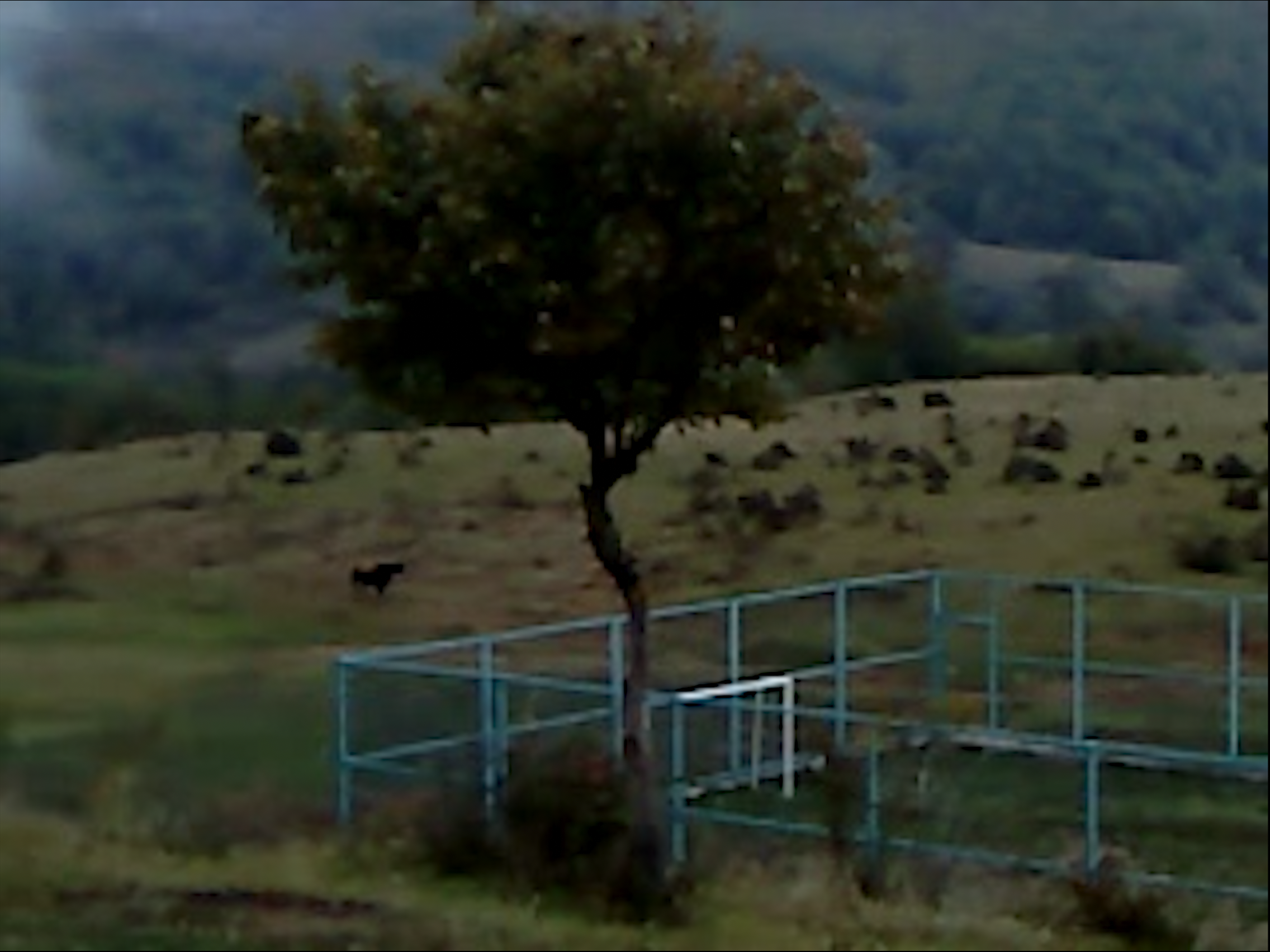
MH: In the second part of the film, at least that was my impression, he shows Lisa’s photo less and they’re finding fewer football fields. There’s more room for contemplation, and a kind of despair starts creeping in. There’s that moment when he asks one of the invisible boys, who’s just said there’s no football field in town: “If there’s no football field, where do you play?” And the boy answers: “Everywhere.” Do you see this as a reflection on hope?
AK: It’s interesting, because when you have material like this — repetitions of the same actions in different places — you suddenly have a lot of options. The question becomes: what logic do you follow in the editing? Do you try to respect real geography? Do you follow some other thread? Or do you just throw it all in the air and see where it lands?
Of course there are certain things that make more sense at the beginning or at the end, but many moments could go anywhere. What I started doing was to put the film roughly in the order it was shot — not entirely, but close. And that, in a way, reflects how our way of working was +changing. At the beginning, I had more of an urge to make it narrative, to push the film in a direction. Later I became calmer, more open to what the film wanted to be, and more aware of what was actually interesting. What you describe is very much connected to that — on one hand, the character trying to do more, and on the other, me as a filmmaker trying to intervene more, especially early on.
As for hope: in the beginning I felt the stress you always feel when you start filming, that need to be active, to shoot every day, to make something happen. But gradually we learned that instead of pushing, instead of hunting down what we wanted to capture, we had to trust, to hope, that something would appear. That was a real lesson. When we filmed again one year later, I was much calmer. Especially in the last months, I really enjoyed it. And that calmness — that trust — is, for me, the ending of the film.
Interview by Matilda Hague
Disclaimer: This page is for your personal use only. It is not to be duplicated, shared, published or republished in whole or in part, in any manner or form, without the explicit permission of the publisher, author, and copyright holder(s) of the images.