
Loading cart contents...
NYFF62 CURRENTS: Program 6: Poetry is Not a Luxury
Poetry Is Not A Luxury, Currents’ sixth shorts program, positioned legacies of resistance—spanning continents, generations—at the brink of disappearance. A trace, be it a photo, a sound, a piece of graffiti, sparks a reverie of grasping recollections, disconnected fibres fraying out of focus. Each film in this program attempts to make note of what has disappeared while taking stock of what hasn’t.
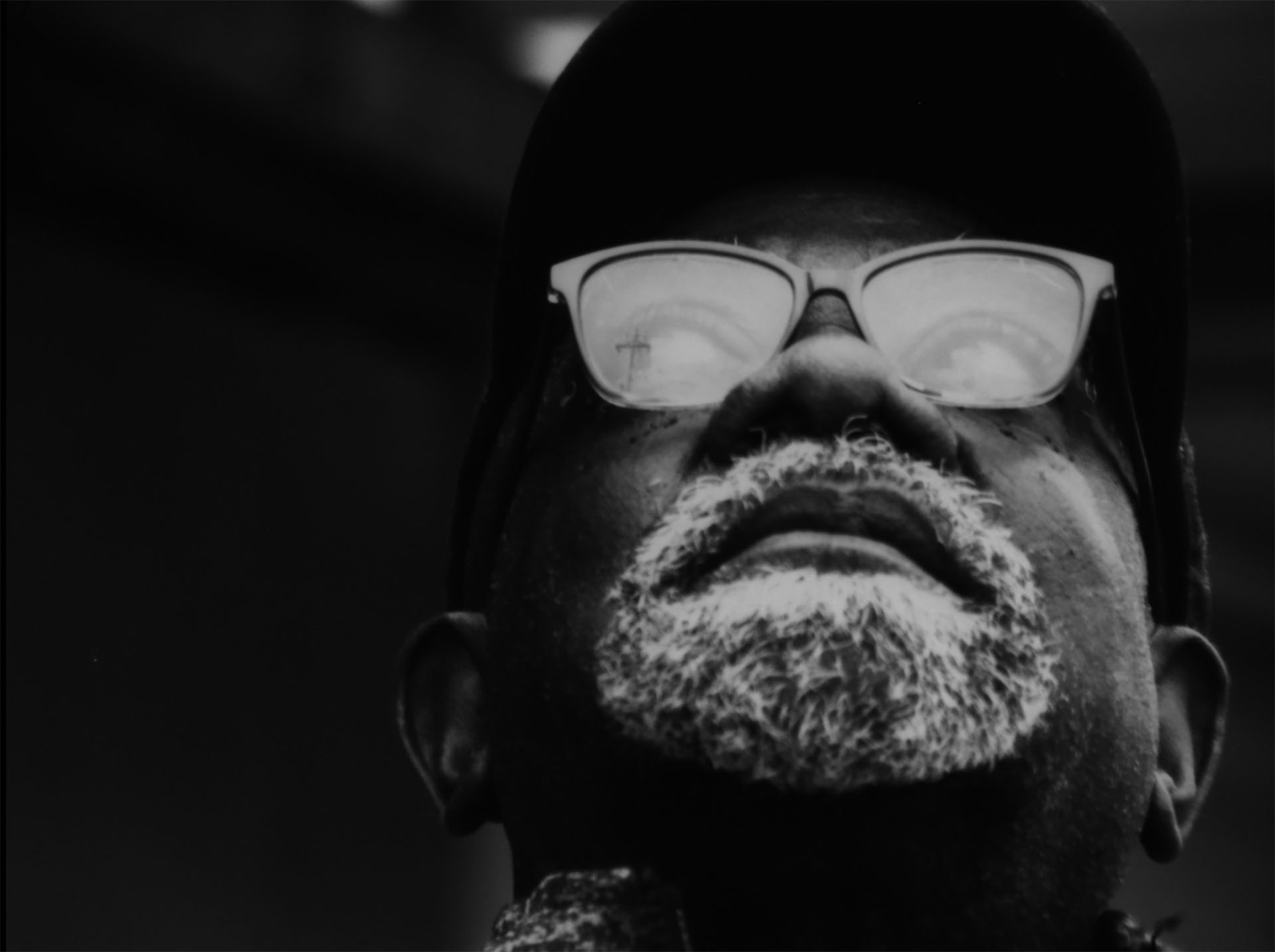
Memory, like activism, is work. In Kevin Jerome Everson’s relatively insubstantial Practice, Practice, Practice (2024), action lays on a continuum of working/resisting/remembering. The film tells the story of Richard Bradley, a black man, a socialist, who, in 1984, thrice climbed a flag pole to remove a Confederate Flag hung outside San Francisco City Hall after it was twice re-installed under orders from then-mayor Dianne Feinstein. Everson’s film makes ample use of a surviving photograph of Bradley’s ascent, coupling this documentary evidence with a contemporary interview with a telephone company employee who speaks about the practicalities of pole climbing in his work. He then cuts to an interview with Bradley, now seventy-three, as he reminisces on his act, before returning to the man from the first section.
Practice, Practice, Practice stretches over decades and a continent in its abbreviated history of racial injustice and resistance. The opening shot rests on a plaque commemorating the victims of the Orangeburg Massacre of 1968, when police officers opened fire on college students and activists protesting a segregated bowling alley. Bradley himself has long since decamped back home to South Carolina, where he’s filmed here. 1968, 1984, 2024—Orangeburg, San Francisco, D.C., where Feinstein later made her second residence during her senatorship, as Bradley mentions. For the great distances they span, the ties that bind these threads appear all the stronger: resistance, memory, and work. Bradley trails off at the end of his monologue: “Three times was a lot of climbing…” Everson cuts back to the phone company employee, who wanders in and out of frame, as the camera holds still, seeming to focus on the middle distance just beyond him. He resumes his advice for pole-climbing on a hot day. The work is slight, coming from Everson. It’s an airy film, with perhaps an overabundance of space for contemplation. And yet the point stands: Much work has been done, yes, but more still to do.
October Noon (2024), a 12-minute short from Chilean-French filmmaker Francisco Rodrígues Teare, is similarly concerned with what testimony survives action, though whether its testimony precedes further action seems a more nebulous prospect. Five years following the initial student demonstrations against a subway fare increase in Santiago, and two after the ensuing referendum rejected a new national constitution, effectively ending the octubrismo moment in Chile, October Noon documents a search for traces.
Teare’s present tense is a forest where a group of thirty-somethings reminisce on a revolutionary potential that seems all but dissipated. A voice relates the events of October 2019 as someone releases a string of helium balloons into the sky, and the camera ventures into Plaza Baquedano (Plaza de la Dignidad, as it was known during the protests), scanning the footprints imbricated over the square’s gravel paths. The voiceover recalls a presence, the images find a lack, and Teare’s soundtrack shifts the inquiry to the edges of perception. “Every sound we’ve made must remain somewhere,” a voice says—certainty mixing with desperation. We hear distorted grumblings resulting from pressing a microphone to someone’s abdomen. There’s a static muffle as we see sound wiring being buried underground, a memorable image from a film otherwise preoccupied, somewhat to its detriment, with impermanence and absence. It’s a film about defeat and recovery that can seem understandably, if unfortunately, exhausted. Both Practice and October Noon dramatize history’s transcription into memory in faint and fading ink, scanning ever further for something to hold onto, a perpetual re-tracing that struggles for wholeness.
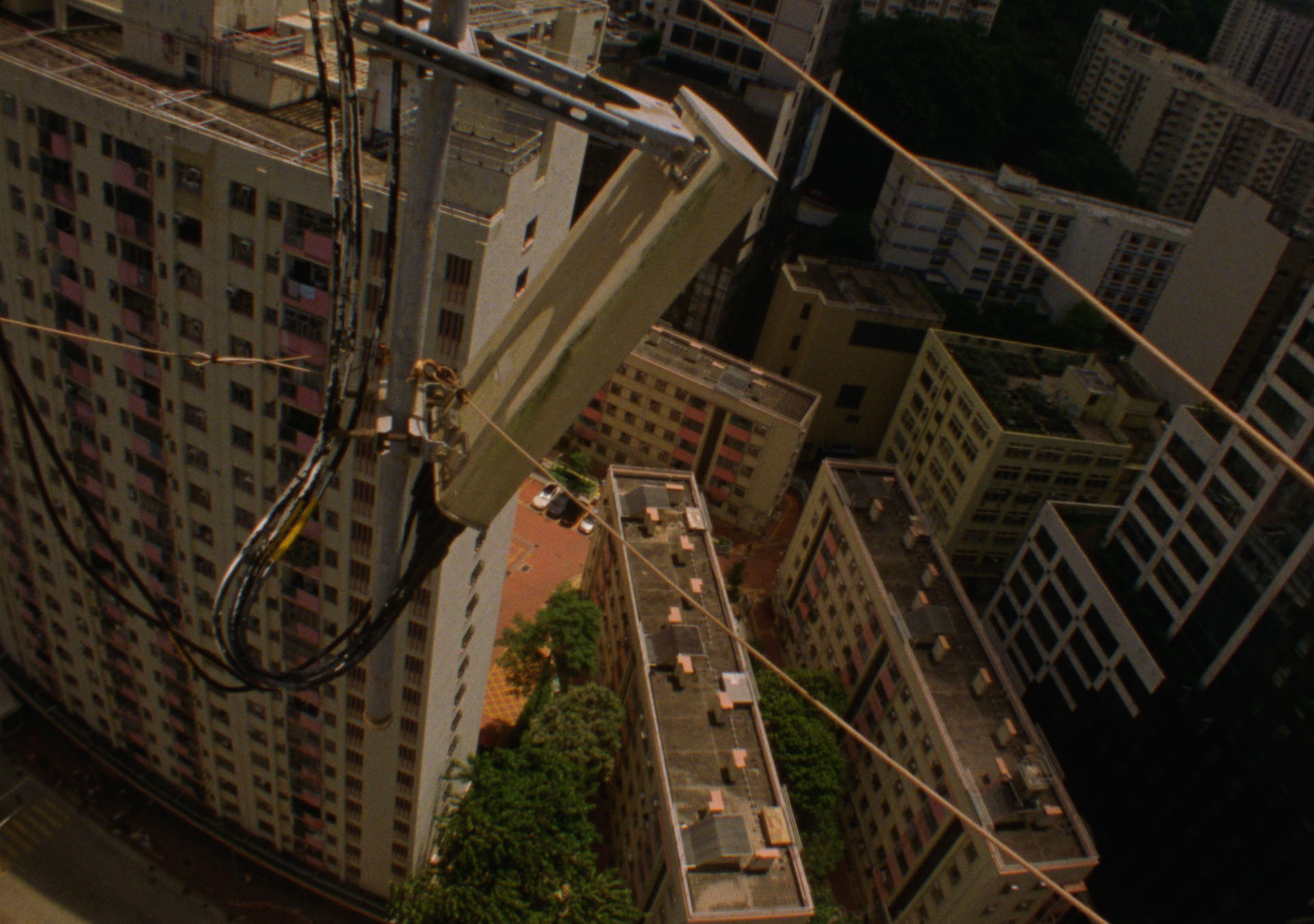
Refuse Room (2024), the latest from Simon Liu, seems to take place at a point beyond which wholeness or comprehension can be considered, and perhaps as a result appears as the most energetic film in the program. It’s shot in Liu’s native Hong Kong, whose dense urban architecture Liu poses as a web of expressways, skyscrapers, and transit lines whose primary function is to distort, reframe, and obstruct. The city is caught in between, as ever—whether the types of events that structured Everson’s and Teare’s work have passed or are still to come is left unclear. What remains are fragments, as if the dictionary required to understand their language has long since been lost. Chaos reigns, and Liu’s artistry is not to appear to orchestrate or channel it, but rather to turn his filmmaking apparatus into a natural extension of this state of affairs.
As is typical of Liu, whose in-camera trickery and multiple projector works have often strove for a vision of meticulously curated randomness, the sounds and images of Refuse Room are presented in a 12-minute procession of discordance. Double and triple exposures leak, flip, and spiral; pointing his camera out of a train window, Liu sees apartment lights blur into steady streams of abstracted light. When Liu pauses the onslaught—and it seems a feat of immense strength and dexterity when he does—it is to observe how the ‘human’ persists in this increasingly post-human landscape. He finds a man staring into space from a balcony; graffiti of a lizard with a speech bubble reading “Papa.” The soundtrack’s whirring and clicking relents in time for a few echo-y radio frequencies of a forgotten pop song.
It’s a pessimistic vision: one of a post-human world still replete with humans, in which language can no longer house memories. One prefers to think of Refuse Room on a hypothetical later point on the timeline. The working/resisting/remembering continuum was interrupted, sidetracked on some glowing highway. To climb a pole is not the simple solution it once was. As the urgency of the task increases, so too does its obscurity.
Review by Dylan Adamson
Disclaimer: This page is for your personal use only. It is not to be duplicated, shared, published or republished in whole or in part, in any manner or form, without the explicit permission of the publisher, author, and copyright holder(s) of the images.