
Loading cart contents...
A Conversation with John Smith, Part 2
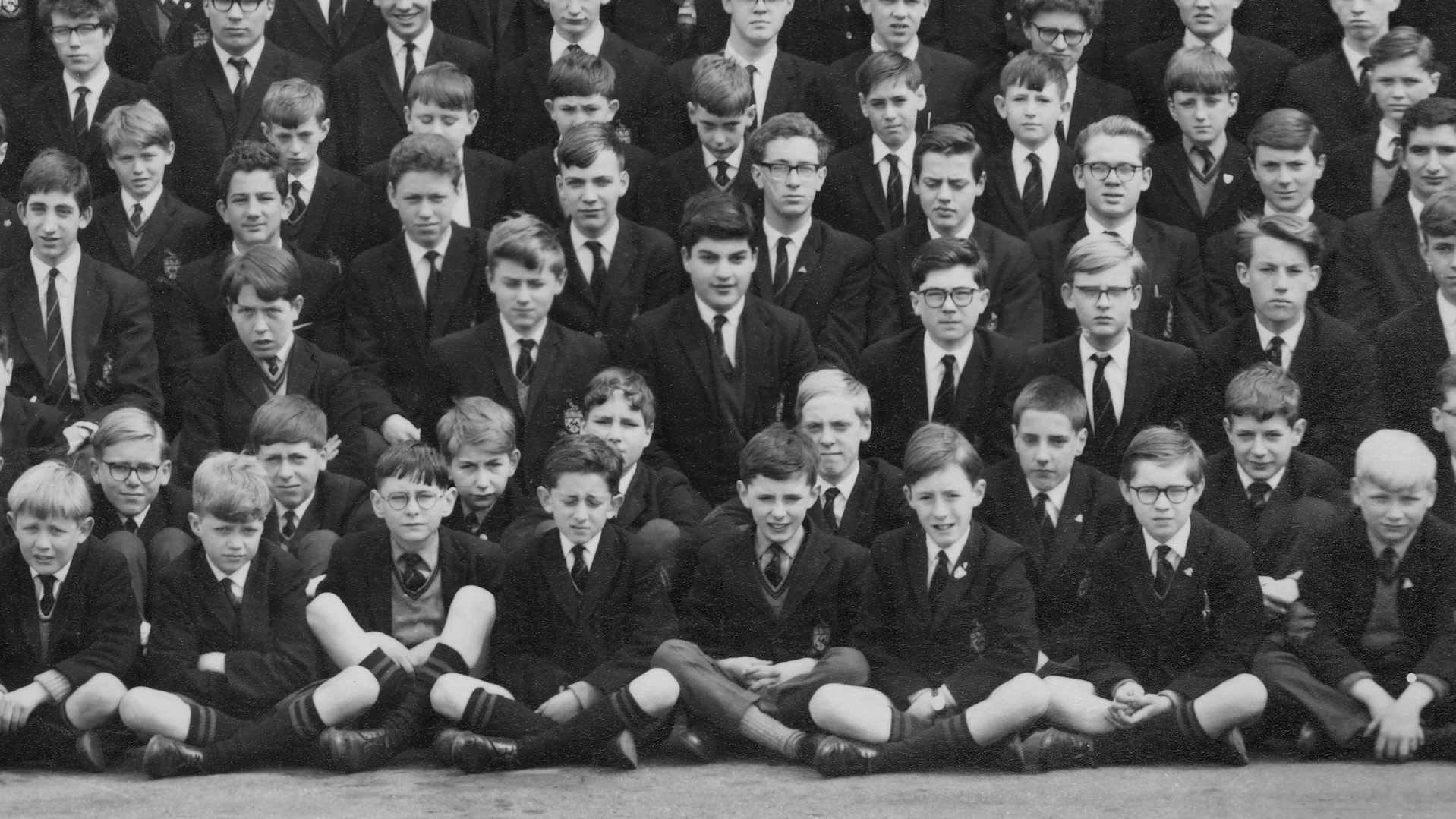
SB : In Being John Smith (2024), too, multiple traumatic events caught my eye. There’s the personal trauma of being called John Smith, which leads to being nicknamed “Big John” or “Piddly Smith.” The image that others have of you becomes a traumatic experience. But parallel to this, you also mention what’s happening in Gaza. These events, both personal and global, prevent you from doing your work. Then, the word “ceasefire” appears on the screen.
JS : Yeah, well, that statement is fundamental to the film because it comes completely unexpectedly, which was the intention. It disrupts the film in the same way everyday life is disrupted for me, and hopefully for others as well. At certain points during the day, you might see or hear something that, while not directly related to the genocide, triggers thoughts about it. For example, I might see someone walking down the street, and something about them—maybe their shirt or the colors they’re wearing—might remind me of Gaza. They might be wearing red, green, and black, and I’d think, “Oh shit, what’s been going on for so many months?” When I wrote the script, the situation had only been going on for three months, and it was surprising that it was still happening then. Now, of course, it’s nearly 18 months, and it’s still unbelievable.
The other reason for including it in the film was that I made a resolution to mention Gaza whenever I showed my work publicly—not just in this film, but whenever I did a public performance or talked about my work. So, I decided to put it in the film, and in that way, it became ingrained in the film. It’s a reminder of what’s happening and what we didn’t do to stop it. That was important. Also, in countries like Germany, it’s nearly illegal to mention the word “genocide” in relation to the events in the Middle East. So, I thought, I’ll put this statement in the film, and if film festivals don’t want to show it, they can fuck off. I only wanted to show it in places sympathetic to that position or at least open to allowing that perspective.
SB : In relation to what we were talking about earlier, it emphasizes the idea of being unable to produce any images while being traumatized by the images around you.
JS : Yeah, absolutely. I was very pleased last night when people clapped. It was the first time, after showing it many times, that there was a definite response from the audience who applauded. And of course, with a big audience, it only takes ten people to empathize with something, but nevertheless, it was quite interesting.
SB : The film also refers to and shows your brain cancer and the treatment, which ties into the idea of an image being something you experience—connecting it to an embodied experience, a direct impression on your own body. We can make a parallel between your own brain cancer and the way you experienced growing up, as well as how you look back at these images and moments. What’s curious to me is the very direct, literal link between the body and what it experiences.
JS : I was interested in making a film that, although based on autobiographical material, could be universal enough for others to identify with. Specifically, I wanted to explore the function of making art during times of crisis, and the doubts one feels about its value—whether you could be doing something else. It also touches on the process of getting older, how one experiences the world, and how perceptions of what’s going on around you evolve. It was important to me to express that I move further to the left every day as I get older, not to the right.
To be honest, when I’m making a film, I don’t overthink it. It just flows. One thing leads to another, and I’m constantly thinking about how to connect each part to the previous one. I didn’t do a lot of soul-searching while making this film; I simply went with what came to my head. It could have been much longer, as I have so many anecdotes I could share, but there were connecting themes around how we feel in terms of being special or part of a group.
The most important part for me is the ending, where I’m celebrating anonymity and the lack of ego—how everyone in the crowd is just celebrating themselves as part of a group. This connects to the song Common People, which was the starting point of the film. Initially, I had shot some footage for something else, but it didn’t work out. Then I thought about the people singing Common People, and I realized I had been thinking about making a film related to my name. It struck me that I have the most common name in the English-speaking world, and that was the trigger to make the film—after capturing that shot I really liked, looking down on the crowd.
SB : The other night, I saw James Benning’s new film Little Boy (2025). It’s really striking how he also plays with the idea of rewriting or inventing one’s life, something you criticized in Being John Smith. But he takes it in a different direction, creating a community by bringing together different people and experiences. You see this in the way these people connect with us through their hands and their painting. In a way, his personal retelling of his life also ends with the need to rebuild empathy and community, which is a similar idea to the one we started with, but approached from a different angle. The collective experience of violence pushes us to recreate community, and that same idea plays out in the rebuilding of one’s personal life. Does that resonate?
JS : Absolutely. I’m very wary of nostalgia, but at the same time, I think we inevitably look back and think things were simpler then. They were simpler, yes, but also we tend to see them in a distorted, seemingly simpler way, even though life is always complex. In Benning’s Q&A after the screening, he said that the models in Little Boy resembled the buildings he grew up with in Minnesota. He mentioned how he became really obsessed with the research on what colors to paint these buildings, aiming to make them look as much like the ones he remembered from his childhood.
SB : I also wanted to talk about Hotel Diary 1 (Frozen War, 2001) and the mediated relation to violence. In the film, you comment on the image frozen on your TV set in a hotel, and the voiceover says, I quote: “America started bombing Afghanistan, dreading what the news tonight was going to be. BBC News 24, I’m confronted with a static image, and it’s been this way for maybe 10 minutes now. I’m looking at this image that has been frozen at 1:41. A second night of strikes completed, targets in Kabul, Kandahar, and Jalalabad hit.” Then you go on to add that you can hear people shouting outside the hotel. Trauma becomes an experience between spaces, and you make a parallel between what you hear from your hotel room and what can be heard in Afghanistan: “I’m sure in Afghanistan, the voices are raised to an even higher pitch.”
Three spaces are thus involved: here, elsewhere, and the screen that connects the two. To me, it really becomes clear when you say, “This image is creating a fear, an insecurity about the place where I live, and this fear is coming from the fact that this image on a TV screen is frozen as if time has just stopped. Shock, disbelief.”
JS : The film was made after I’d been in America on September 11th, which was less than a month before then. I had been in New York until September 10th, and then flew to Chicago that same day. On September 11th, I woke up and saw on live TV the World Trade Center being attacked. It wasn’t a great time to be stuck in America, especially with all the patriotic fervor that erupted. Like many others, it was a very traumatic experience, and my sense of reality became distorted by what happened.
When I arrived in Chicago, I stayed with a friend who was the director of Video Data Bank, a distributor of artists’ video based at the Art Institute there. She was someone I knew from London, and we stayed up late talking and drinking. At one point, she said she needed to go to bed because she had to get up in the morning to look at new work submitted for distribution. The next morning, when I woke up, she was watching TV in her living room, and I saw the second plane hit the second tower. I looked at the screen and thought it was a special effect. She laughed hysterically, saying, “It’s real, it’s real.” But I still thought it was a joke.
Less than a month later, I was at the Cork Film Festival. I went back to the hotel late at night, turned on the TV, and saw the image frozen on the screen. I thought it might be something related to London. It was 2001, so I had no awareness of hotels having servers for TV. The image being frozen seemed related to the transmission, and I thought there might have been a bomb at the BBC center. I was still in this hyper-traumatized state, so I was really annoyed at myself for being affected by a technical glitch while knowing that my country was dropping bombs on Afghanistan and killing innocent people. There I was, sitting in a comfortable hotel, in a completely different reality, and my trauma was triggered indirectly, through no discomfort for myself. I was very aware of my privileged position at that moment.
That awareness of my privileged position runs through Hotel Diary and connects to what we discussed earlier about the interjection of “ceasefire” in Being John Smith. The constant reminders of conflicts elsewhere, triggered by small stimuli, are present in both works. The first part of the diaries, with the frozen image, directly relates to something happening at that time, whereas the later parts, while more constructed, use the hotel room as a metaphorical space. The hotel room is impersonal, anonymous, and it represents the link between the outside world and personal experience.
The film examines how information about what’s going on outside is filtered through the media, and we’re left questioning whether we can trust what we’re being told. And in terms of the humor in the film, I believe humor is a very serious thing. It can contrast with the traumatic moments to make them feel even stronger. Sometimes, you laugh at something, and then something serious is revealed, and you wonder, “Should I laugh? Or shouldn’t I?” Talking about wars is never really a laughing matter, but when I talk about my cancer treatment in the film, there’s a line that I think is quite funny. I say, “I now have a perpetually dry mouth, matching my dry sense of humor,” but people never laugh at it. It’s interesting because they’ve been identifying with my cancer, and now they’re unsure whether to laugh or not.
I deliberately create discomfort in my films. I think it’s important not to make a film an easy ride. Some parts should be easy, but there should also be moments that make you question what’s funny, heavy, or surprising. It might be cruel to the audience, but I feel compelled to do it.
SB : I think people laughed at it. It was just a different kind of laugh, a quieter one. It relates to something I was saying to a friend of mine yesterday about your work—how your editing brings out humor in such a unique way. It’s about changing the rhythm, the tone, and the pace, so you can’t just laugh in the same way the entire time. It makes your sense of humor so unpredictable, because you never know how the next cut or joke will land.
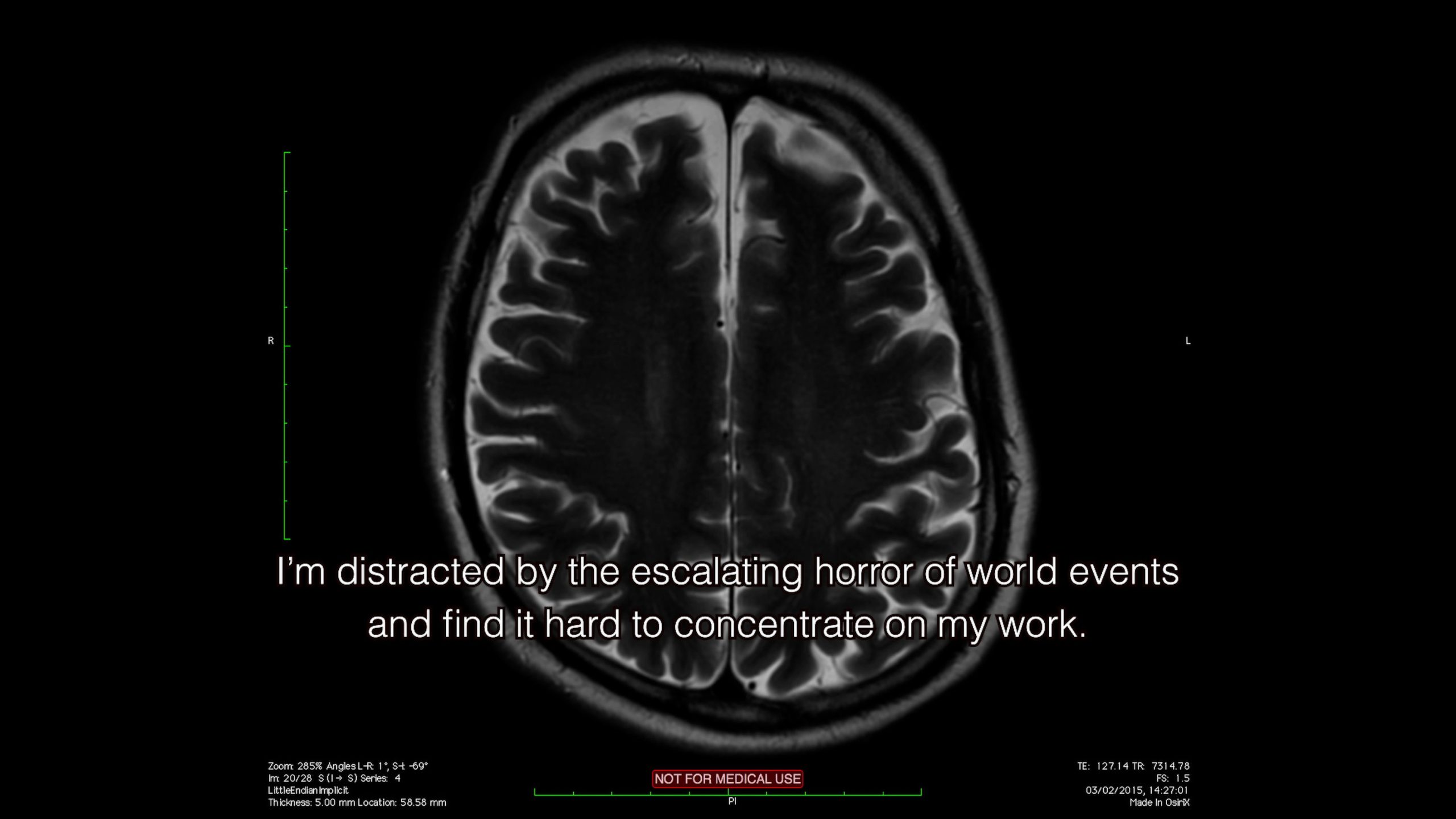
At some point in Being John Smith, you say something like: “People say that as you get older, you get more conservative, but I’ve only been moving further left.”
JS : The thing I find really disturbing that I’ve heard recently is that, for example, Trump has a strong following among 18- to 35-year-olds. So, I’m not the only older person who feels this way. I grew up in the late ‘60s when it was all about peace and love, and we thought we were going to change the world. I grew up in a time when you didn’t trust politicians. I’ve never trusted mainstream politicians, no matter their persuasion.
SB: The situation right now is scary to me in two ways. First, I’m worried that we might become so immune to these images that we stop reacting to them. But I’m also worried about how traumatic they’ll be for the generation experiencing them in their early teenage years. What kind of world are we going to build after living through this traumatic present?
JS: Yeah, I feel the same way. It’s hard to understand when we think about how we rightly hold the Holocaust in such high regard. How can we not look at what’s happening now in the same way and condemn it just as strongly? It’s just horrific.
SB: “Never again” was supposed to apply to everyone.
JS: I find humor to be a serious thing, but when I showed the film in Toronto for the first time, people were talking about my fears for the future of humanity. In an interview, I said, “I don’t have children, so I don’t have to pretend the world isn’t ending.” And this got quoted. But honestly, that’s how I feel. I just can’t see the human race surviving.
SB: What was the headline of the article? “John Smith doesn’t give a fuck?”
JS: No, it was just quoted in an interview. It didn’t pass judgment, but somebody said to me afterward, “That wasn’t a nice thing to say for people with young children.” But, I think one has to be unrealistic about survival. It doesn’t really help. I wish I was less pessimistic, but I can’t help it. I have to make a joke about it.
Interview by Samy Benammar
Disclaimer: This page is for your personal use only. It is not to be duplicated, shared, published or republished in whole or in part, in any manner or form, without the explicit permission of the publisher, author, and copyright holder(s) of the images.