Loading cart contents...
Location
Anthology Film Archives
32 Second Avenue
New York, NY 10003

Anthology Film Archives
32 Second Avenue
New York, NY 10003
2 December 2026
7:30 PM – 9:30 PM
Program Notes.
This program consists of films discussed in Millennium Film Journal no. 84: Circulation. Celebrating 60 years of the Millennium Film Workshop, the issue surveys the landscape of contemporary experimental film distribution, and what it means to make experimental images today.
Programmed by Grahame Weinbren, Vince Warne, and MFJ editors.
Chantal Akerman PORTRAIT D’UNE PARESSEUSE (SLOTH) (1986, 7 min, digital)
“Akerman’s contribution to the anthology film SEVEN WOMEN, SEVEN SINS (which also features shorts by the formidable Helke Sander, Bette Gordon, and Valie Export) is an amusing portrait of the director trying to overcome her own laziness (i.e., to get out of her bed by noon) in order to make her film about sloth, all while her partner Sonia Wieder-Atherton is hard at work. (The scenario produces Akerman’s oft-quoted line, ‘In order to make cinema, one must get out of bed.’” –TIFF
Marthe Peters HENRY IS A GIRL WHO LIKES TO SLEEP (2026, 14 min, digital)
“One sleeps so as not to have to exist: ‘I do think going to sleep is one of the very best things for people who are unhappy.’ Sleep here is not laziness, it is not carelessness, nor is it linked to sin; it is intimacy and comfort; it is a body that curls up like a cat to overcome vulnerability and everything else. Like a snail that retreats when the outside world is all a threat, the narrator also wants to curl up in her blankets and withdraw into herself. This letter addressed to Henry seems, after all, an attempt to overcome the fear of feeling in the form of a declaration of (self-)love to a cat.” –Margarida Moz, INDIELISBOA INTERNATIONAL FILM FESTIVAL
Andrea Luka Zimmerman WHILE THE GODS WERE BUSY WITH ANOTHER CHILD (2026, 25 min, digital)
“Once I make a film, I must let it go and allow it to spark conversation, critique, or whatever responses people bring to it. Showing it to my students and to others was incredibly enriching, and I’m aware that public-facing discussions may bring a range of reactions, especially around survivorhood and visibility. For me, though, it’s not about self-presentation but about resisting the individualization that shapes so much of our culture. In my films I create spaces for people who are usually marginalized or spoken about in limiting ways, and I use myself in that same framework. I grew up being told that leaving school at 13 or 16 meant you were destined to become a criminal or a failure. Then, if you become something else, people say, ‘You did so well, you made it.’ It’s like a binary society. But lots of lives are much more enmeshed in each other. We need each other, right?” –Andrea Luka Zimmerman, interviewed by Georgia Korossi for London Short Festival 2026
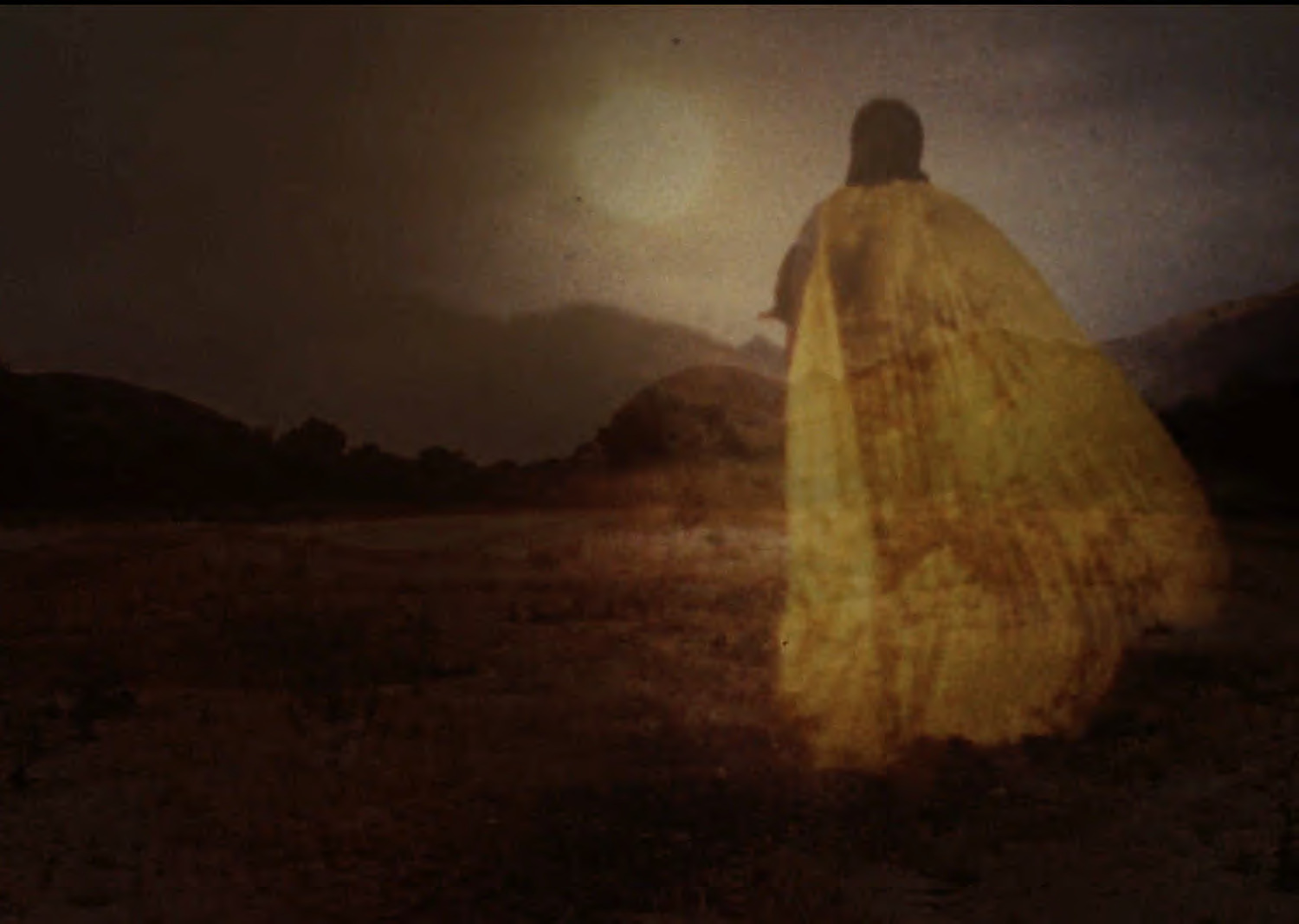
Charlotte Pryce THE GLOAMING (2026, 14 min, digital)
“Pryce’s films are known for being as soft as they are meticulous, made out of both filmed footage and manual manipulation. Given how Pryce is so rooted in nonconformity and imagination, her attention to the surface of the film’s skin stands out. By themselves, her films are all-consuming handcrafted windows into unpeered realms, that may reach the audience in layers. From the presence of a fluid image on a single subject, whether it is an animal, a plant, a book or an obscure unnamed substance, many others follow suit and outwardly open the field of vision. Pryce…looks at the craft as an artisan storyteller. It takes both a lot of control and attentiveness to let go and fully embrace the multi-sensory act of discovery of works best understood as constructed fictions.” –Susana Bessa, “Charlotte Pryce rips through the veil of invisibility,” MFJ 84
Barbara Hammer SAPPHO (1978, 7 min, 16mm-to-digital)
“Barbara was so interested in experimenting with form and particularly the materiality of film and of filmmaking. Her last piece – really, her masterpiece – was EVIDENTIARY BODIES (2016). In that work, her body literally dissolves visually into a film strip. The idea is not only BARBARA FOREVER, but Barbara’s legacy – that she would live on in her work. Her work is so personal, it is so much about herself, her body, her sex, the things she’s discovering. But she was also very wide ranging in how she approached the materials.” –Brydie O’Connor, interviewed by S. Topiary Landberg, “Life-affirming art is the point!”, MFJ 84
SAPPHO will be preceded by an excerpt from Brydie O’Connor’s LOVE BARBARA (2026).
The Millennium Film Journal is affiliated with Millennium Film Workshop, Inc.
Email: mfj@millenniumfilmjournal.com
Web: millenniumfilmjournal.com
Copyright © 2026 by Millennium Film Workshop, Inc. ISSN 1064-5586
Distributed internationally by Central Books.
This program is partially funded by NYSCA through the Millennium Film Workshop.
The Millennium Film Workshop gratefully acknowledges support for the Millennium Film Journal by the following individuals and organizations:
• Deborah and Dan Duane
• Walter and Karla Goldschmidt Foundation
• C. Noll Brinckmann
• New York State Council on the Arts
• Anonymous Donors
• Our Advertisers
If you’d like to support the publication of the Millennium Film Journal with a tax deductible gift, please access https://millenniumfilmjournal.com/donations/donation-form/