
Loading cart contents...
Continuous Energies: A Kumar Shahani Retrospective at Prismatic Ground
A king states, “We regard life as memory. Death is its pinnacle” while he drifts through a dim, stone room, his white regalia luminous as heat lightning. The camera tracks his slow, ponderous movements, as it will later track through woodlands, desert-scapes, and the surface of a river. The fluidity of the cinematography in Kumar Shahani’s 1988 experimental film Khayal Gatha intimates the king’s train of thought, as well as the steady progression of time. Khayal Gatha, the first of Shahani’s filmography to receive international acclaim, is a hypnotic exploration of the origins and evolution of the Khayal form of classical Indian singing, but it’s also a rumination on memory and forgetting, as evidenced when a woman later notes, “there is no melody without recall.”
This past May, the New York film festival Prismatic Ground, now in its fifth year, honored the memory and legacy of Shahani’s work at the Anthology Film Archives. The retrospective included screenings of Bhavantarana (Immanence) (1991), Birah Bharyo Ghar Aangan Kone (The Bamboo Flute) (2000), Kasba (1990), and Khayal Gatha (The Khayal Saga) all of which were projected on 35mm. Shahani, who passed away last year at the age of eighty-three, was a member of Indian Parallel Cinema movement, otherwise known as New Indian Cinema, an artistic film movement that originated in the 1950s in West Bengal concurrent with more mainstream Indian commercial cinema. He was a contemporary of Satyajit Ray and Mrinal Sen, among others.
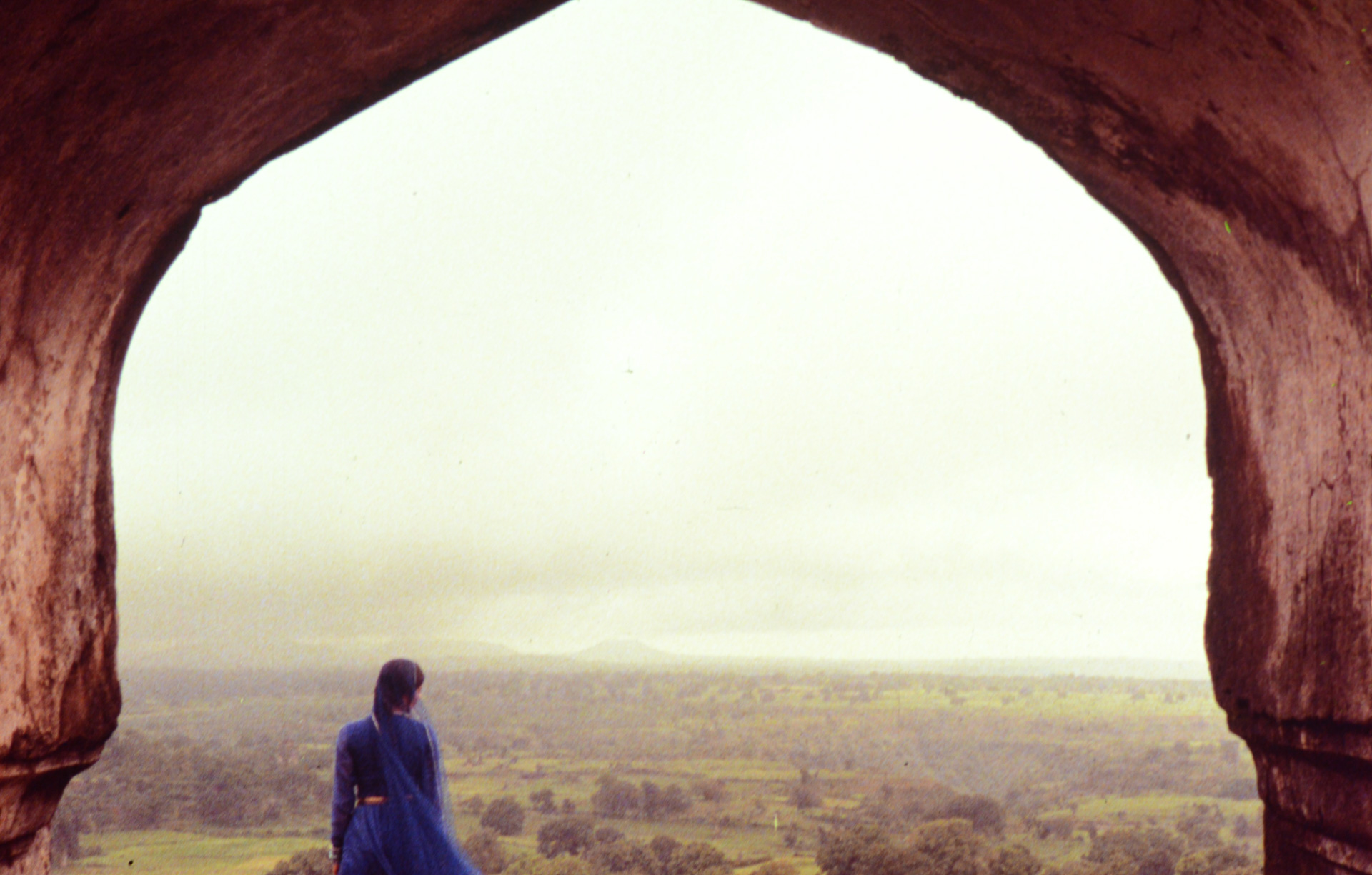
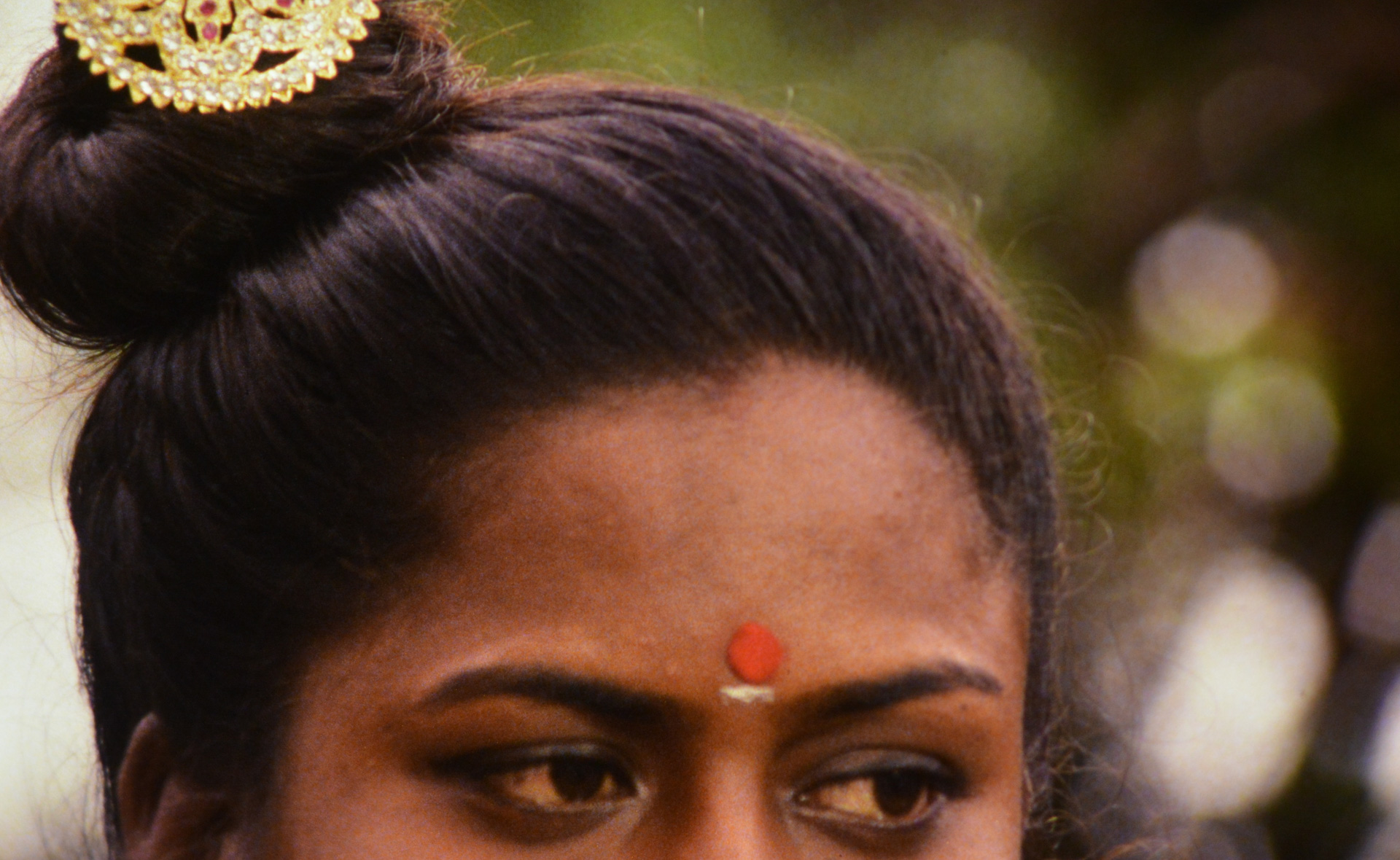
Shahani studied at the Film and Television Institute of India (FTII) in Pune where he was mentored by the filmmaker Ritwik Ghatak and the historian-polymath D.D. Kosambiand. Later, he served as an assistant to Robert Bresson who was a major cinematic inspiration for his own work. You can see certain European cinematographic influences in Khayal Gatha, as when the camera tilts up, tracking the gilded ceiling of the palace, much like numerous shots within the palatial château from Alain Resnais’s Last Year at Marienbad (1961) to intimate a soporific, oneiric state. The tracking shot is an apt way to intimate stream of consciousness, but also to survey space. Given the rich mise-en-scene in each of Shahani’s films, the desire to cover all that ground is strong. And given that throughout Shahani’s career, but particularly in Khayal Gatha, he drew from a range of aesthetic practices, including painting, music, dance, and epic performative traditions of India, the wide shots and tracking shots hold room for peacocks, masjids, and the fecund Indian landscape.
As critic and curator Geeta Kapur notes in When Was Modernism: Essays on Contemporary Culture Practice in India (2000), “There is an extreme condensation of art forms in their continuum through the centuries. At the same time a displacement of one art form into another is introduced so that each of these becomes part of the metonymic chain that reconfigures Indian poetics as a vastly imbricated and structurally replete system that is still fully alive” (358). In other words, Shahani’s films challenge Western cinematic notions of time and space through an amalgamation of international cinematic, aesthetic, and political references and influences.
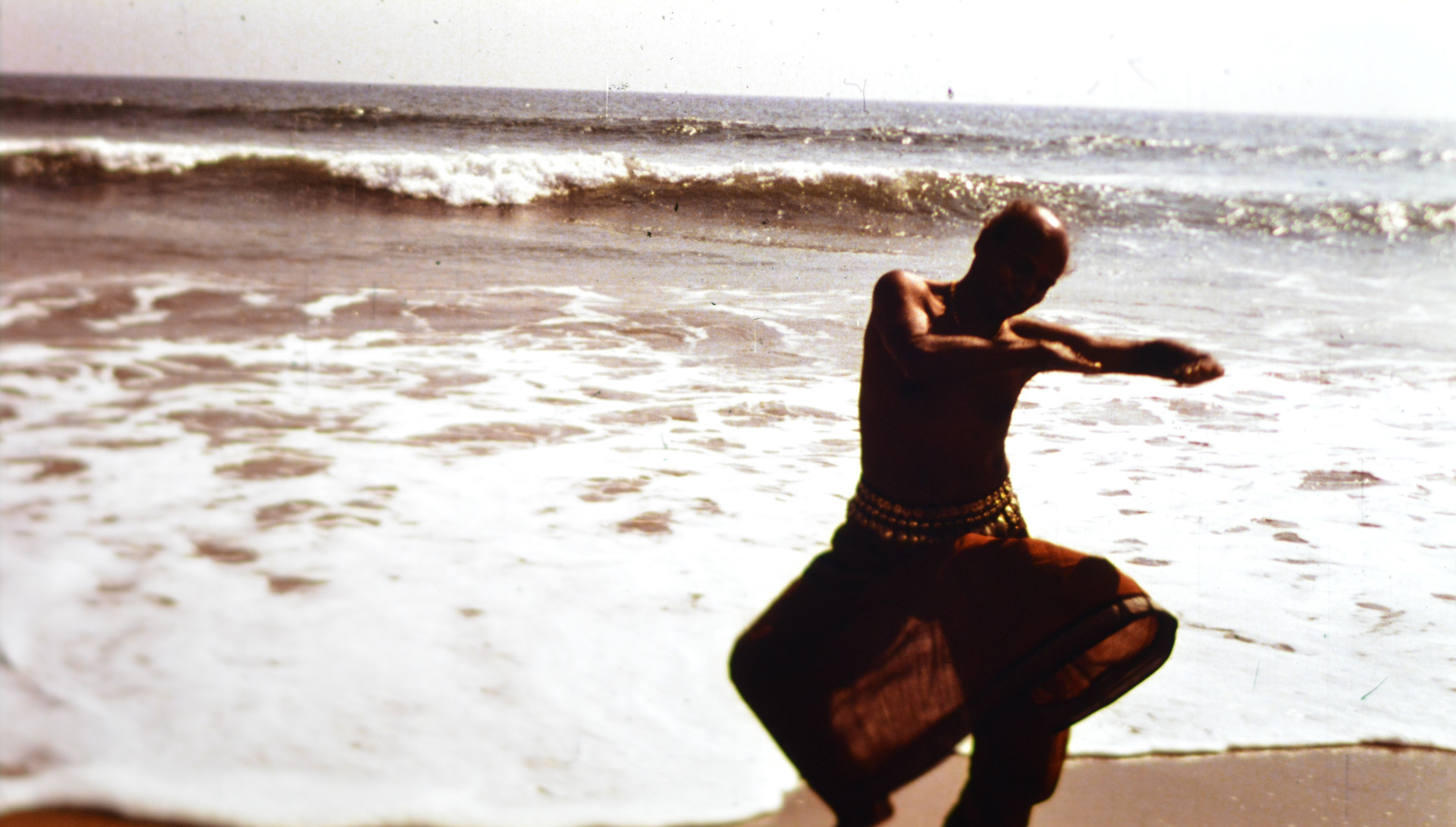
The opening of Bhavantarana exemplifies a textured, if not textural, richness through a close-up sequence of Odissi dance maestro Guru Kelucharan Mohapatra’s body undulating amidst stone. The sheen of his skin coupled with the reddish, rutted topography, creates an abstraction of glinting surfaces whose radiance catches, and pleases, the eye. The camera then pans away to a wide shot to reveal the larger sun dappled landscape lush with trees and a throng of birds. After a couple of minutes, the camera pans back to Mohapatra, now framed in a long shot, as he continues to move. The warm colors and light evoke a visual and gestural vibrancy that brings to mind Shahani’s own meditations on the sensorial effects of film: “Like music, the cinema is experienced as a continuous, live process of energies. It is conceived and best remembered in a flash, a composite whole.” The haptic close-ups of contracting muscles induce an embodied awareness of celluloid’s energy as well as the dancer’s physique.
When reflecting on what it meant to include Shahani’s work in this year’s festival, Prismatic Ground founder and curator Inney Prakash enthused:
Kumar Shahani is one of the great film artists of the last fifty years and his work is virtually unknown and unseeable in the west. The opportunity to show four of his films in their original format at this year’s Prismatic Ground was above all a deeply personally gratifying gift— this was work that I longed to see projected— and beyond that was an exceedingly rare chance for New York cinephiles to be introduced to his work, which for me at its best exists on a spiritual plane visited upon only by very special artists like Tarkovsky or Bresson.
Prakash’s sentiments underscore how Shahani’s work is, above all, deeply felt. In his documentary The Bamboo Flute, Shahani highlights the titular instrument, an instrument that is predicated on the body and its breath. Thus, this documentary foregrounds forms of touch. While the flute is important to Indian culture writ large, its music moves through, and with, the body, as so many elements in Shahani’s films often do. In The Bamboo Flute, a voice-over states, “The pulsating pressures of Touch open the doors of hearing.” Later, a montage of cows chewing hay and a butter churn add additional visual and sonic layers to the film’s underlying, ongoing soundtrack. Here, another door has been opened, activating yet another sense. Inhalation and exhalation proliferate. In Shahani’s films, the live process of energies sparks the narrative and formal engine as well as our ears, hearts, and minds.
Review by Hannah Bonner
Disclaimer: This page is for your personal use only. It is not to be duplicated, shared, published or republished in whole or in part, in any manner or form, without the explicit permission of the publisher, author, and copyright holder(s) of the images.