
Loading cart contents...
Re-encounters: Malcolm Le Grice’s Expanded Cinema in Amsterdam
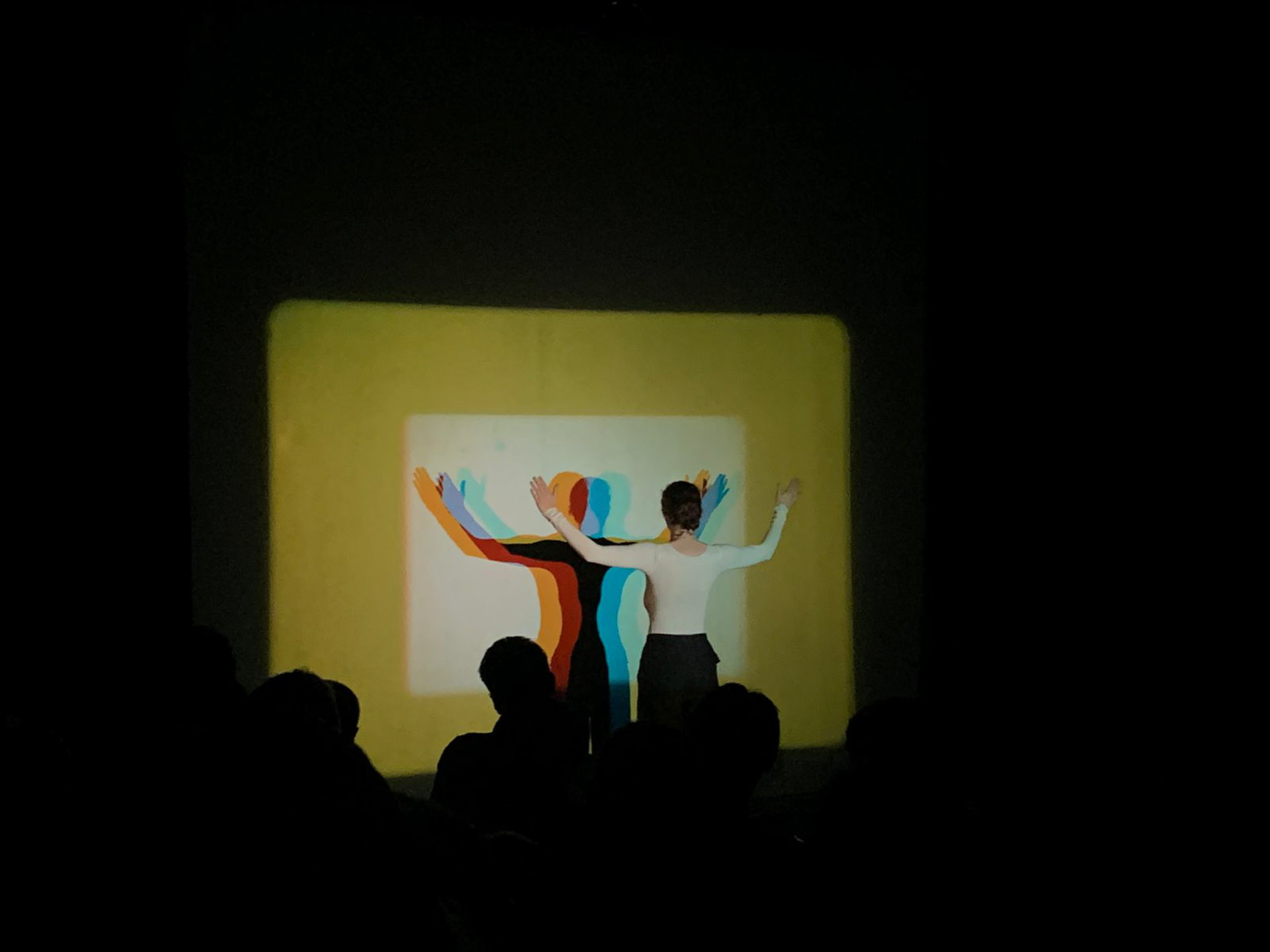
Last December, I spent an evening at the Amsterdam Film Meeting – an annual film festival in its second edition – which occasioned the chance to witness two expanded cinema works by British Experimental filmmaker Malcolm Le Grice (1940-2024). The showcasing of Horror Film 1 (1971) and After Manet, After Giorgione – Le Dejeuner sur l’Herbe or Fete Champetre (1975) at Filmhuis Cavia was not unique, in the last decade Australian artists Lucas Ihlein and Louise Curham have re-enacted Horror Film 1 at several venues, and earlier in 2025, Art Cinema OffOff in Ghent showed After Manet, but rare enough to contemplate the significance and implications of staging these older expanded cinema works in the current media ecology.
In the early 1970s, Le Grice’s name was readily associated with expanded cinema since he frequently employed multiple projectors and performance in his work; Jonas Mekas once called him the most important artist in this field. While the integration of film with live action in performances by artists like Carolee Schneemann and Yvonne Rainer represented one direction of intermediality in the fertile mediascape of the 1970s where film was a means of infusing recorded time into the present-now, Le Grice’s and Britain’s Filmaktion group’s interventions were leading towards an altogether different direction – the rejection of retrospective time in favour of the real-time of a film projection event. Back in 1972, Le Grice penned an essay called Real Time/Space that in many ways laid out the stakes for such experiments by advocating for the desertion of a pre-recorded time and space – the basis of the mystificatory devices of narrative cinema – in favour of live enactments involving a film projector in front of the audience. Written just two years after the publication of the fabled Expanded Cinema by Gene Youngblood and emerging out of the similar countercultural the-only-rule-is-that-there-are-no-rules moment of the late 1960s, Le Grice differed from Youngblood on at least one significant count: the latter was convinced that technology was the all powerful absolute truth and its ever transformative and spectacular force, a redoubtable boon, whereas the former was treading on a cautious political path that pursued the one holy grail of avant-garde art, the active and emancipated spectator freed from the spell of media manipulation.
It is in this backdrop that Le Grice conceptualised and realised Horror Film 1. First staged in 1971, this film-performance used color film-loops running through three projectors, the one casting the central image using a zoom lens with an accompanying single-channel tape sound of breathing, as the body of the performer – historically Le Grice himself, nude or shirtless – moves in a straight line with arms outstretched, from the destination of the light to its source, the screen to the projectors, casting increasingly complex colored shadows by intercepting the projector beams directed at the white surface. In referring to horror in the title of the film, Le Grice retrieves what for many like Jacques Tourneur, is the genre’s cardinal feature, the shadows. At Cavia, Horror Film 1 was performed by Betija Zvejniece, who had earlier done so at the European Media Arts Festival (EMAF) in Osnabrück, 2025. This re-enactment or repetition, inherently incomplete, opens up several questions on subjects of originality, archiving, interpretation, and adaptation. Performance Arts by nature rely on the uniqueness of each performance – repetition with variation is one way of putting it – untethered from any notion of rigid originality as in painting. Venues, audiences, and physical bodies of performers are expected to change, resize, or age, but such adaptability is less negotiable when it comes to the artist-performer. Whether substituting the artist as performer in such a case de-authors the performance is one question, yet another, as far as analogue expanded cinema is concerned, is if in doing so, we enter the realm of archiving? If restaging has an archival claim in the absence of the artist, it is distinct from documentation via photographs, videos, and instructional notes. It remains invested in the experiential, which is a critical part of the original work, something that is not accounted for in conventional archiving strategies. Alternatively, it is equally logical to consider restaging as an adaptation or an interpretation, as with musical performances of older compositions. The impact of the body of the artist and its relationship to novelty of the performance hinges on several factors, for example if the body is the medium of the work as in feminist performances, or if it channels more neutral perceptual concerns as in the case of Le Grice (granted that such distinctions are not always straightforward). In the performance of Horror Film 1, the gender switch, between Le Grice originally, and in this case, Zvejniece, inadvertently brings up the question of conventional gender roles in the horror film genre, of active males and passive females, and possible subversion of such stereotypes.
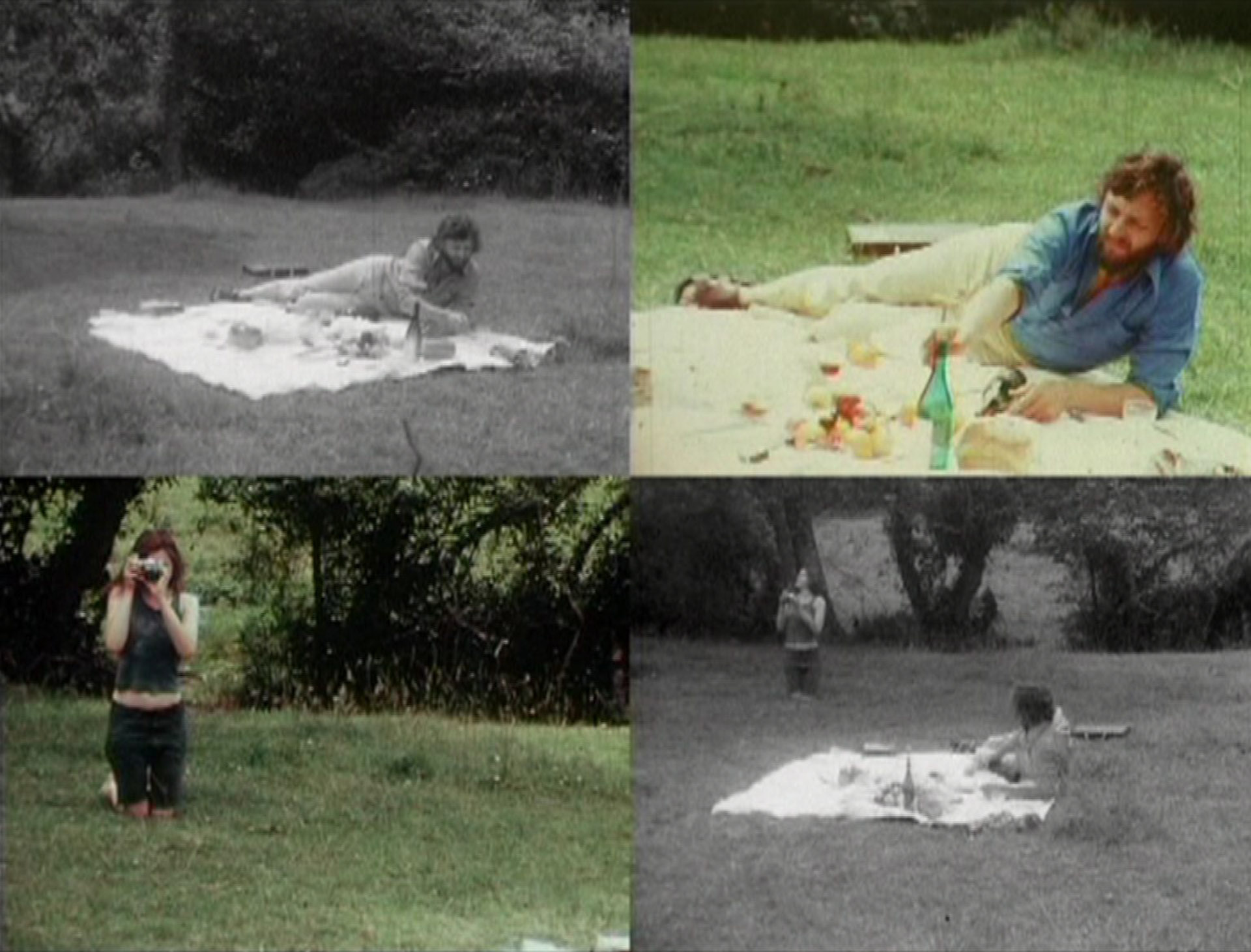
Take away that “unresolved” body from the room and re-staging suddenly has to tackle less pressing questions about the integrity of the cinematic work, which is the case with the other multi-projector film of the night, the hour-long After Manet. In it, the intermittently synchronized 4 projectors cast a 2×2 grid on the screen that combines into an overall 4:3 configuration. Like Horror Film 1 that solicits Da Vinci’s The Vitruvian Man, here again Le Grice, who came to filmmaking from painting, draws upon a motif from art history, one that was popularised by the French painters in the 18th century – the Garden Party – explicitly referring to two portrayals, one an early precursor of the genre by Giorgione (Le Concert champêtre, 1509), and the other, a late variant by Manet (Le Déjeuner sur l’herbe, 1862). For the film, Le Grice and three of his compatriots from the Filmaktion group – Annabel Nicholson, William Raban, and Gill Eatherley – individually took charge of one camera each. The different quartets – the filmmakers, the cameras, the screens, the film stocks (Black and White and Color film in both positive and negative) and the four projectors – together depict a spatially fractured scene of a picnic, with the four filmmakers switching their positions between in front of and behind the cameras. The generated perspectives, either through variance in framing or through the positioning of the recording cameras, in combination with the discontinuous locationally-faithful soundtrack and the altering film stocks, offer an unusual representational model that continuously challenges the viewer to construct their own coherent description of the depicted scene. Le Grice here really stretches out the conventional projection situation, replacing montage, or possibly masking techniques, with a different simultaneity of images, allowing us to choose, if we intend to see a single screen divided into four parts or four screens adjoined together.
Multi-channel audiovisual productions of documentary nature and empiricist assertions are much more popular in the art exhibition context as well as in the wider moving image environs today than anti-illusionist experimental film practices. There is a perception that the messy clutter of analogue film projection in exhibition spaces undermines the films themselves. Though the premise might seem reactionary since it rallies for the usual abstraction of the apparatus, there is a case to be made against films that tend to leverage the routine optomechanical aspect of analogue projection – its sculptural presence on view, now suddenly transformed into a spectacle owing to its cultural rarification – over intellectual clarity in the projected image. Expanded Cinema today, circulating in specialized film festivals and alternate venues, too often finds itself in that conceptually exhausted phenomenological dead-end. Works like Horror Film 1 and After Manet, even in the absence of their authors and in their adapted incarnation, can provide an escape route from the double bind of documentary dominance and insipid materialism.
Review by Arindam Sen
Disclaimer: This page is for your personal use only. It is not to be duplicated, shared, published or republished in whole or in part, in any manner or form, without the explicit permission of the publisher, author, and copyright holder(s) of the images.