Loading cart contents...
Location
2220 Arts + Archives
2220 Beverly Blvd.
Los Angeles, CA 90057

2220 Arts + Archives
2220 Beverly Blvd.
Los Angeles, CA 90057
18 January 2026
7:30 PM – 9:00 PM
Program Notes.
Over the last half-century, the Millennium Film Journal has charted seismic transformations in the way we create and look at moving pictures—from 16mm celluloid to magnetic videotape to digital “content creation,” and now the strange new world of AI-generated deepfakes and simulations. All along, we’ve kept an eye on the Hollywood Dream Factory, which has often thrived in the chaos of technological change—though of late its fortunes are fading, with studio workers and artisans suffering most. It is a curious impasse. Compared with the narcotics of Netflix “autoplay” or the debut of virtual actors, like the imaginary Tilly Norwood, the fantasies of the industry’s erstwhile Golden Ages seem vivid, achingly human, recalcitrantly real. As we drift into a surreal future, we want to glance backward, or at least collect the traces of our cinematic pasts. Real Life—the latest edition of MFJ—is a study of this diachronic gray zone, and the Journal joins with Los Angeles Filmforum in showcasing a handful of works discussed in its pages, along with others we admire.
Elise Rasmussen is a research-driven artist working with lens-based media. She has exhibited internationally at venues including the Brooklyn Museum, Queens Museum, Belvedere 21, Sharjah Art Foundation, and the University of Queensland Art Museum. Her work is in the collections of LACMA and the Museum of Contemporary Photography. She holds an MFA from the School of the Art Institute of Chicago and has attended residencies worldwide. Her work has been featured in Artforum, ArtReview, Art in America, and BOMB. Born in Edmonton, she lives in Los Angeles.
Michael Robinson is a film, video, and collage artist whose work examines the emotional mechanics of popular media and the instability of shared realities. His work has shown internationally at the Whitney Biennial, London’s National Portrait Gallery, REDCAT, MoMA, and major festivals including Rotterdam, Berlinale, and Sundance. He has received support from Creative Capital, MacDowell, Yaddo, and the Wexner Center. His work has been discussed in Art in America, Frieze, Film Comment, and Cinema Scope. Robinson lives in Los Angeles and teaches in the Film and Video Program at CalArts.
Nicholas Gamso is a writer, curator, and professor in the Visual Culture program at California College of the Arts. He is the author of Art after Liberalism (Columbia UP/CBAC, 2022), and his articles and reviews appear in Afterimage, Art Monthly, East of Borneo, e-flux, frieze, Texte zur Kunst, and X-TRA. Nick is co-editor, with Jason Fox, of World Records, vol. 4, and a contributing editor of Millennium Film Journal. In 2024, he won the Wattis Institute’s Open Call with a film about the legacy of Hervé Guibert.
Kate Lain is a Los Angeles–area multidisciplinary artist working in film, video, clay, and other media. Her work explores material, texture, and the ways people engage with the natural world. Lain’s films have screened internationally at festivals including Black Maria, Edinburgh, Videoex, Experiments in Cinema, and Los Angeles Filmforum. Her cyanotypes function as both documents of process and ethereal traces of light and chemistry. She holds an MFA in Science & Natural History Filmmaking from Montana State University.
By Claudia Hart
2022-23/25, digtal, color, sound, 5 minutes. Los Angeles premiere!
In Memory Theater 2, Claudia Hart combines experimental avatar dance, video, and earlier works culled from her personal archive spanning 35 years of continuous media-art practice. Hart mixes a recorded sound collage featuring samples from Campion’s audio compositions produced and recorded for their collaborative performances with a Bach piece used as rehearsal music by Kristina Isabelle, whose motion-captured “stilt” dancing is embodied by Hart’s Bauhaus-inspired avatars. The background video in the scene shows the initial live motion-capture session. In this version of the piece, Hart removed her normal voice-over so that the avatar dance can fully embody her narrative.
“Hart’s uncanny figures and their environments are wholly expressive. They drift, warp, and decay, seemingly under the spell of unknown pressures, whether internal or environmental…”—Claudia Hart: Illuminations, Corinna Kirsch
By Elise Rasmussen
2018, 16mm film transferred to HD Video, color, sound, 7 min.
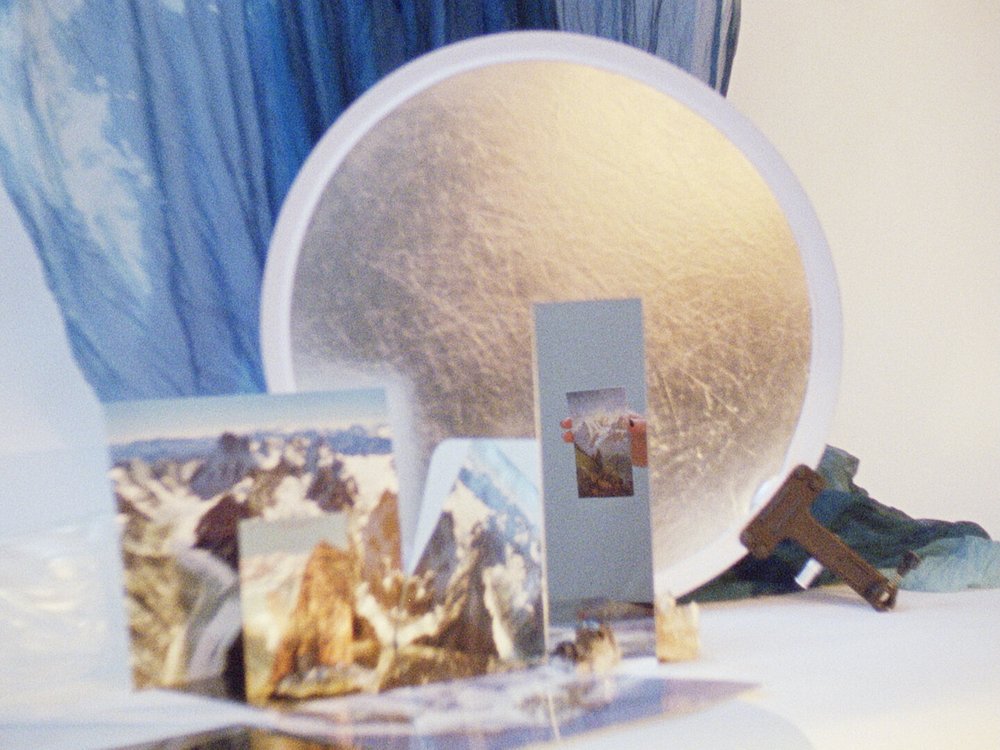
Did You Know Blue Had No Name? explores epistemological aspects of “blueness” through various historical narratives, examining the relationship between the color blue and mountaineering, early photographic technologies, art history and how knowledge is ascribed and recorded. As a starting point, I investigate 18th century Swiss scientist and alpine enthusiast Horace-Bénédict de Saussure’s cyanometer, a device he created for measuring the blueness of the sky. Saussure’s quest to test his apparatus and theories on blue led to a contest inspiring the first expedition to the summit of Mont Blanc, the highest mountain in the Alps. The quest for blue has likewise had challenges in early photography as blue skies were difficult to record leading to innovations such as split printing and challenging the “truthfulness” embedded in the medium. Similarly, in ancient texts, no word for blue exists. The word blue only makes an appearance in recorded language after the color could be extracted for pigment. This project weaves together these and other histories of blue, commenting on issues of [in]visibility, innovation, conquest and the contest. This work is the first in a trilogy of works exploring histories related to the Alps preceding The Year Without a Summer and Nostalgia: A Return to the Alps in Five Vignettes.
By Zachary Epcar
2024, 16mm on video, sound, 21 min. Los Angeles premiere.
Three white collar commuters recall an experience of getting trapped on a train in San Francisco’s transbay tunnel, each drifting into fantasies of sex, death, and other intimacies with strangers.
“A beguiling, spacious, and transportive work of suspended tension, that looks for new forms of intimacy in the antiseptic. An urban office park becomes a reflecting pool for the erotic fantasies of a derailed train where we wait, shake and survive together.” – 25 FPS grand jury
By Justin Jinsoo Kim
2025, HD, color, sound 12 min. California premiere!
The film conducts an elusive search for the traces of Lee Kyung Soo, a Korean War orphan adopted by a U.S. Navy officer. Lee’s image circulated widely across newspapers, magazines, and photographs—serving specific purposes and cultural narratives. Over time, these representations fractured, faded, and reemerged, leaving silences in the archive and gaps in visibility. The cut-out fragments from the scattered information are pieced together to imagine the child’s unspoken point of view throughout his wandering life.
Collaging text and sound along with the grainy distortions of inkjet-printed imagery, Justin Jinsoo Kim’s (Personality Test, NYFF59) refractory archival dig pieces together the story of Lee Kyung Soo, an orphan of the Korean War adopted by a U.S. Naval officer in Westchester. With its careful manipulation of microhistorical fragments, A Real Christmas summons the neocolonial mythologies of the United States in the 1950s through its news media, uncovering traces of alternate voices and narrative lacunae. -NYFF-
By Michael Robinson (The Dark, Krystle, 10’),
2013, HD, color, sound, 9:34
The cabin is on fire! Krystle can’t stop crying, Alexis won’t stop drinking, and the fabric of existence hangs in the balance, again and again and again. – MR
“The Dark, Krystle brilliantly re-purposes the artificiality of stock gesture, allowing viewers to see its hollowness and to feel it recharging with new emotional power. Equal parts archival fashion show and feminist morality play, Robinson’s montage rekindles the unfinished business of identity, consumption, and excess in 1980s pop culture.”— Carrie Secrist Gallery, Chicago
By Matthew Lax
2016, digital, b&w, sound, 4 min.
A shot-for-shot remake of the climax of Tokyo Story (Yasujiro Ozu, 1953). Screen Left uses the original Japanese text delivered orally, with subtitles literally translated into English. Stage Right repeats the scene, with the English subtitles authored by the Criterion Collection delivered orally, with subtitles literally translated back to Japanese. Flanked by abstract “pillow shots” of Los Angeles, the roles of Noriko and Kyoko are played by two Japanese male immigrants in drag, the two English/Japanese versions play against one another, falling in and out of sync rhythmically, textually and spatially.
By Kate Lain
2021, cyanotype and plant material on 16mm film, recorded and finished digitally, color, sound, 5:10. Los Angeles theatrical premiere
“Water Mining (Eaton Canyon)” is a nature film made with a canyon, rather than about it. Its images come from a combination of cyanotype, a blue-and-white photographic process dating back to the 1840s, and actual plant material adhered to physical film. I hand-coated clear 16mm leader with cyanotype chemicals, then used sunlight to make photogram-style, camera-less exposures of plant matter I had gathered in and around the stream in Eaton Canyon, a fairly short distance upstream from where the Eaton Fire of January 2025 started. Cyanotypes are processed using water, and for this film, I used stream water that I had also collected from the canyon. The sounds are layered field recordings of Eaton Canyon, of the film being projected, and of my home in an area that has historically gotten part of its water from Eaton Canyon. I approached the film as though the stream, what was in it, its surroundings, the film, the chemicals, and I were all extensions of one another.
The Millennium Film Journal is affiliated with Millennium Film Workshop, Inc.
Email: mfj@millenniumfilmjournal.com
Web: millenniumfilmjournal.com
Copyright © 2024 by Millennium Film Workshop, Inc. ISSN 1064-5586
Distributed internationally by Central Books.
This program is partially funded by NYSCA through the Millennium Film Workshop.
The Millennium Film Workshop gratefully acknowledges support for the Millennium Film Journal by the following individuals and organizations:
• Deborah and Dan Duane
• Walter and Karla Goldschmidt Foundation
• C. Noll Brinckmann
• New York State Council on the Arts
• Anonymous Donors
• Our Advertisers
If you’d like to support the publication of the Millennium Film Journal with a tax deductible gift, please access https://millenniumfilmjournal.com/donations/donation-form/