
Loading cart contents...
NYFF63 CURRENTS: Program 5: Fields of Vision
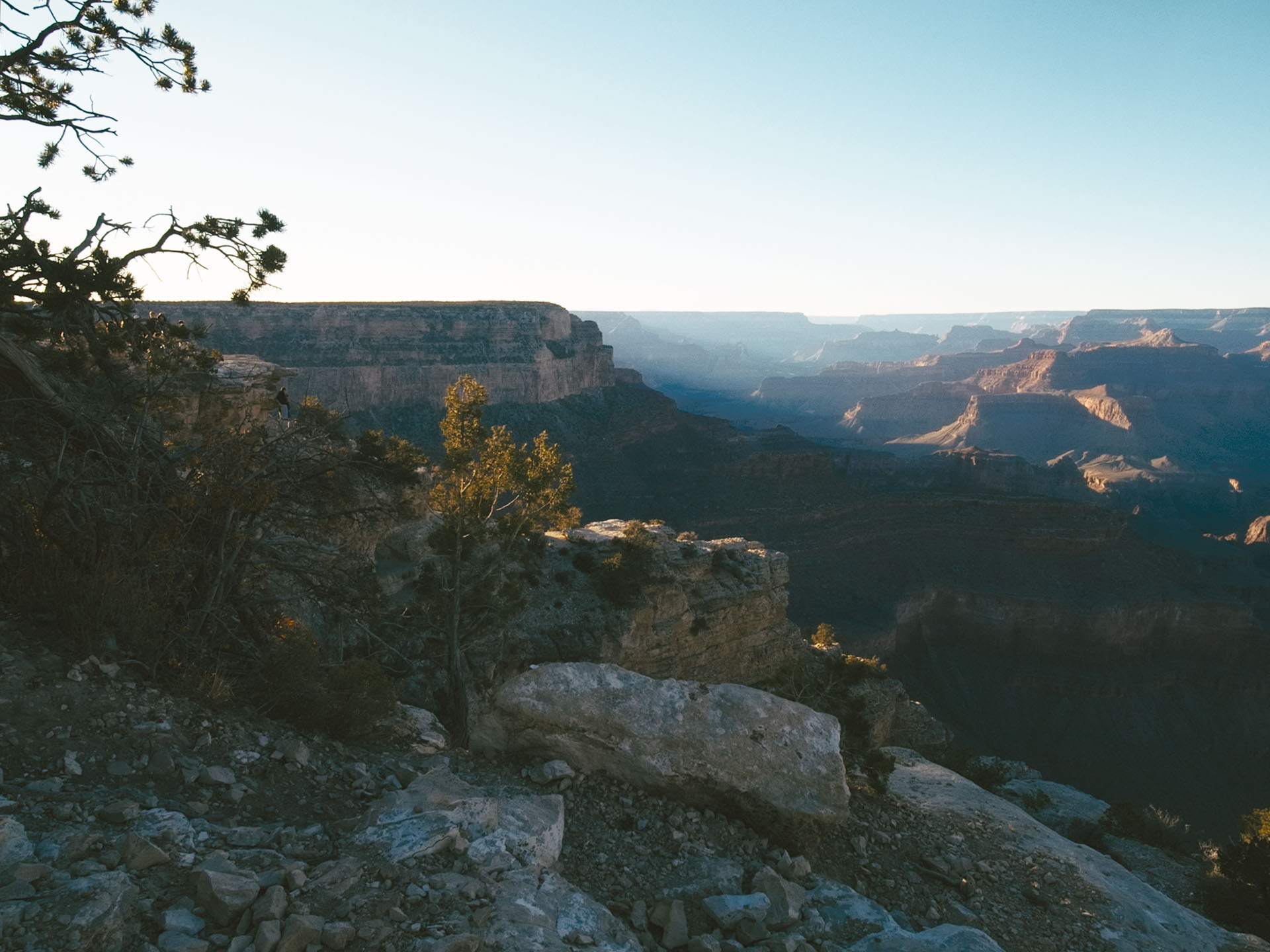
Blake Williams, Felt (2025), frame enlargement. Courtesy of BlueMagenta Films.
In his intro at the first screening of Currents Program 5, New York Film Festival (NYFF) program advisor Leo Goldsmith remarked that 2025 was “a brutal year of loss and grief” within the experimental film world. Notable losses include Tomonari Nishikawa, P. Adams Sitney, and Flo and Ken Jacobs, with Ken’s death occurring two days before the screening. Goldsmith was adamant that this “is not a funeral [or] a seance,” but rather a night to convene in “gratitude for those who made such work possible.” The shorts featured in Currents 5, aptly titled Fields of Vision, gesture at the tactile origins of cinema. Whether filmed on celluloid, in collage animation, or with 3D and digital cameras, these films push forward ways of perception and broaden their roots in structural cinema.
Stereographer Blake Williams gathers footage from the past several years for his newest short, Felt (all films 2025 unless otherwise noted). An extension of Williams’ first 3D short, Many a Swan (2012), Williams remembers his visit to the Grand Canyon with his parents shortly after the 2024 U.S. presidential election, from the vantage point of his temporary residence in Barcelona. In the midst of this recall, he revisits the previous film’s exploration of folding origami paper, expanding its scope to his fascinations. As Williams plays around with the paper, he cuts to abstracted images of the region and archival images of the ocean and Earth. In the decade since Many a Swan, Williams has advanced his artistic vision along with his technology, moving from red-and-blue anaglyph style 3D to the higher-fidelity polarized 3D enabled by the Apple Vision Pro, iPhone, and stereoscopic cameras. Williams’ edits imbue the political, poetic, and personal with the physical as the time traveler searches for clarity in a precarious future. His use of 3D replaces words to articulate angst.
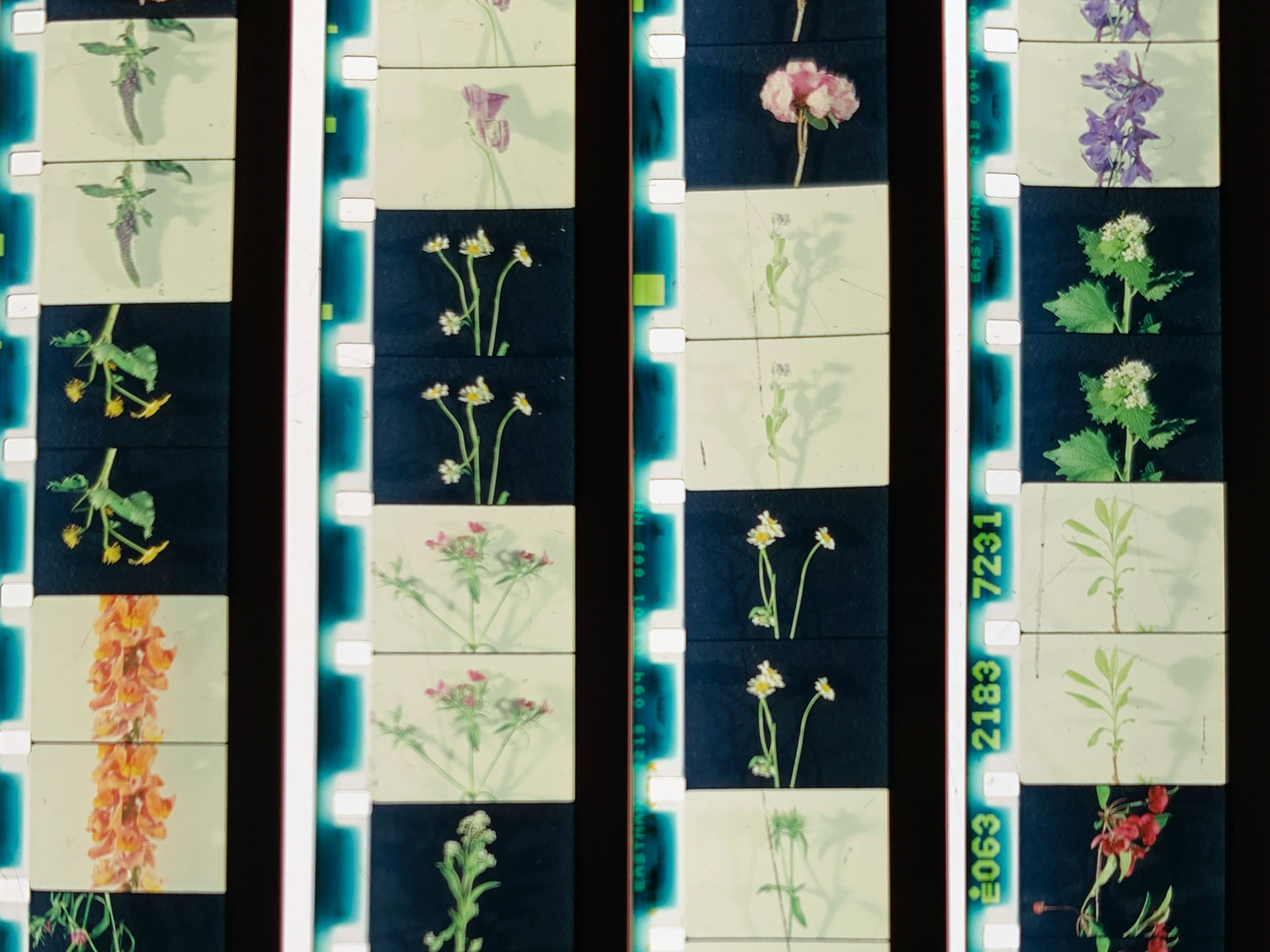
Jodie Mack, Lover, Lovers, Loving, Love (2025), frame enlargement. Courtesy of Film at Lincoln Center.
As Williams explores the limits of 3D imagemaking as a lone wanderer, Jodie Mack leans into the communal with her flowers at her garden in her short Lover, Lovers, Loving, Love. Shot on 16mm and edited in single-frame style like her previous Wasteland films (2017-21), Mack displays the evolution from individuality to partnership amongst flowers at her garden over 14 minutes and 4 chapters (named after each variation on the word love) via frenetic cuts. Once Mack reaches the final chapter, quilts of flowers take over the physical object before they are all intertwined. Her time-lapse edits capture a flower’s longevity before its decay from natural causes. She shows how routines and rituals become memorialized — from physical contact to the illustration of their details via a camera, a paintbrush, and their two-dimensional feel on other surfaces. Bookended by flowers floating in the water, Lover, Lovers shows the importance of care and love for her plants, as well as the reciprocal attention to preserving and storing analog prints. As with Rose Lowder’s minute-long Bouquets series (c. 1994), Mack finds humanity in the rituals of our colorful, oxygen-breathing plants.
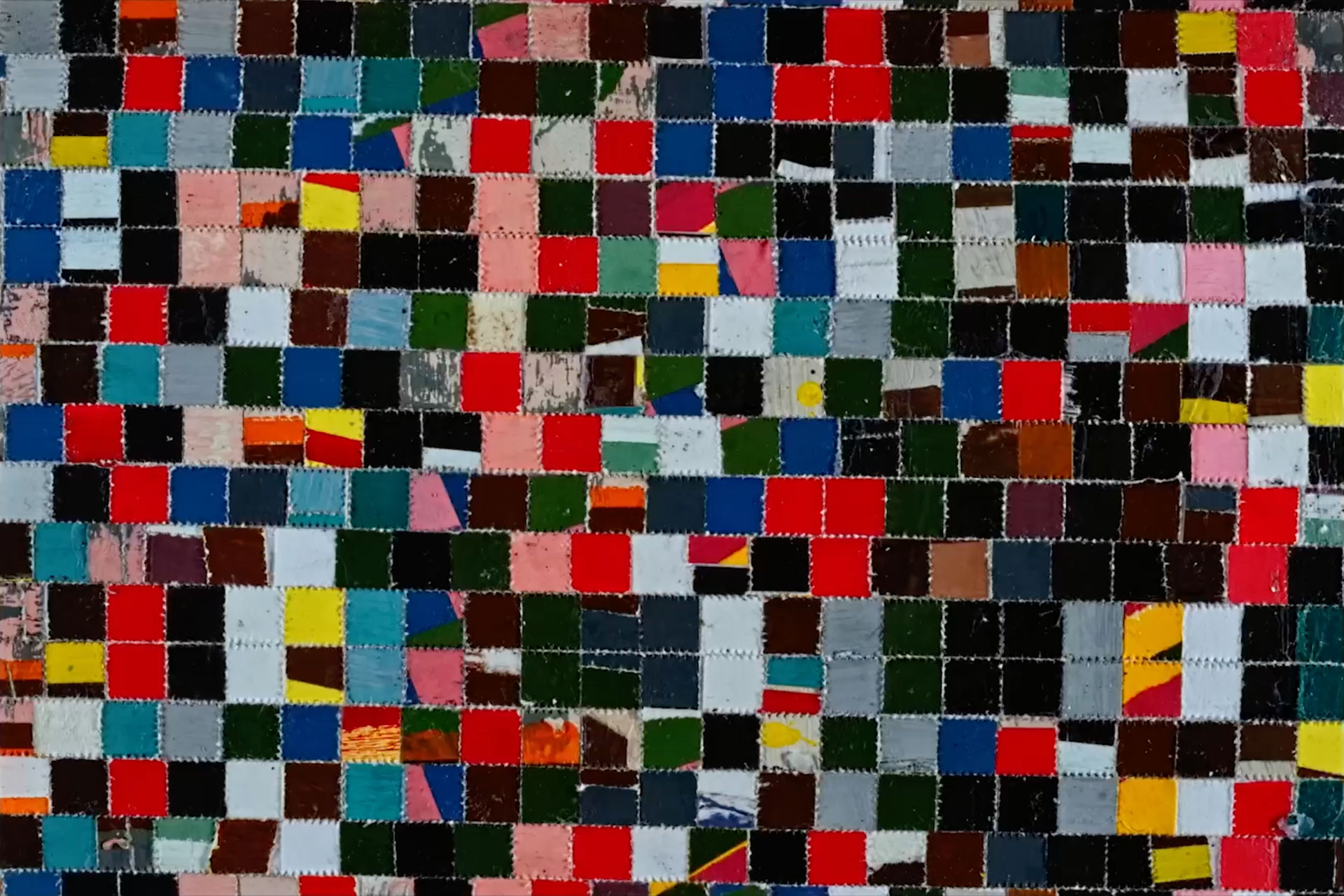
Peter Larsson, Keyhole Conversation (2025), frame enlargement. Courtesy of Film at Lincoln Center.
In Peter Larsson’s animated short Keyhole Conversation, the director presents 10 x 15 cm cardboard frames of his collage paintings. Flickering colors abound in Larsson’s rapid edits. A soundtrack of old cassette tapes, buckets, toys, and a keyboard corresponds with the movement of his paintings. The dialogue within the drawings intensifies when a circular hole is introduced into the film’s penultimate minute. While the film began with Larsson using cuts to generate dialogues between similar paintings, the late introduction of the circle elevates the viewer’s perception of the paintings with an entirely new formal construction. Reminiscent of the fast pacing of Ernie Gehr’s Serene Velocity (1970), motionless images are in full speed as Larsson gives life to each film element and object in the painting. The one-dimensional hole reframes the viewer’s relationship to the paintings, demonstrating the power of presence through absence. Larsson explores how one’s selective thinking and concentration can still be attained even through obstacles and other visual hurdles.
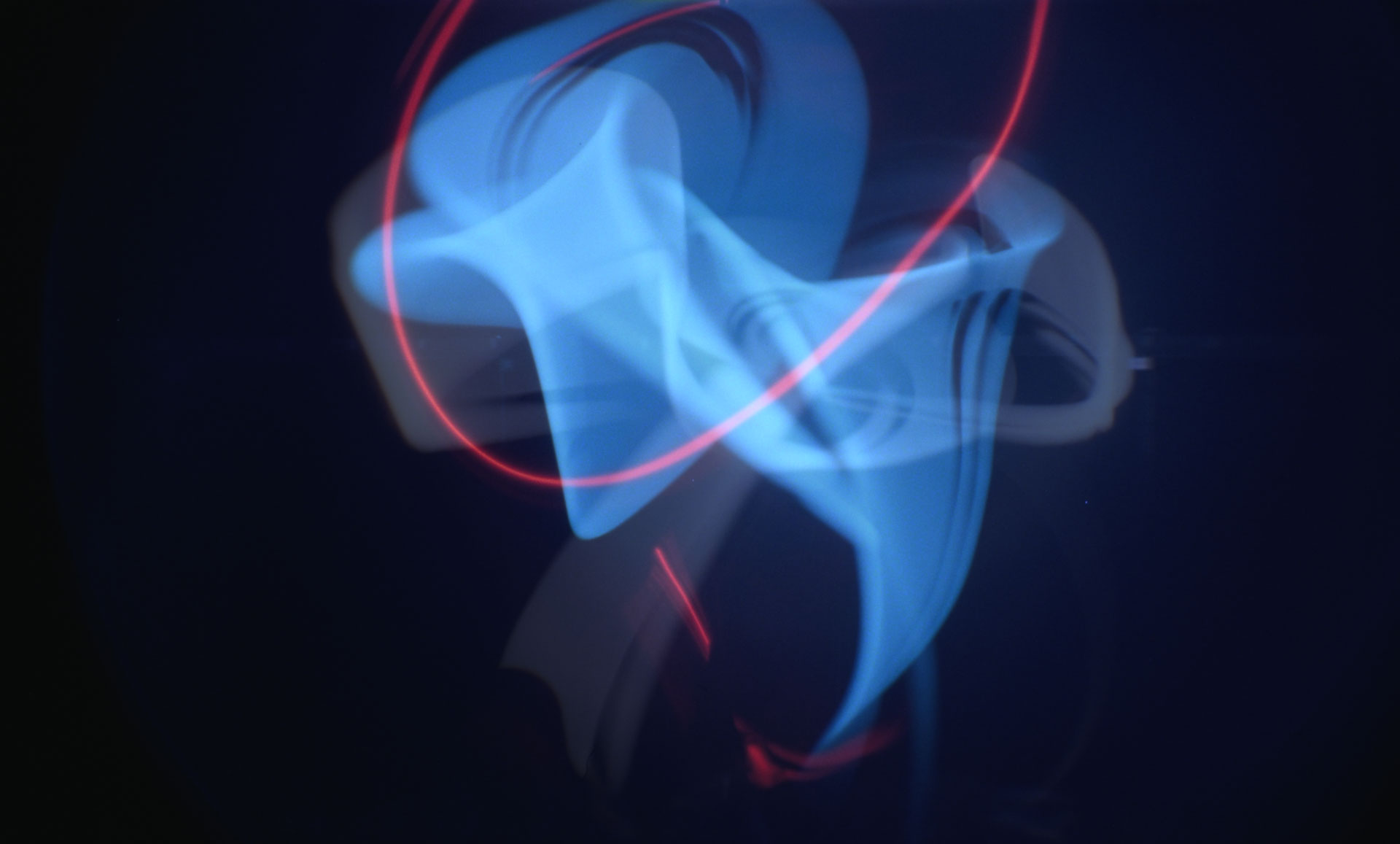
Victor Van Rossem, toward a fundamental theory of physics (2025), frame enlargement. Courtesy of Film at Lincoln Center.
While Mack, Larsson, and Williams heighten the object’s texture through existing technologies, Victor Van Rossem reconstructs the camera itself in toward a fundamental theory of physics. For fundamental theory, Rossem built a 16mm time-slice camera similar to the one Tim MacMillan made while a student at the Bath School of Art in the 1980s. Rossem upgrades the single-lens camera by adding 292 more lenses and exposing the 16mm strip 293 times. The footage from these cameras resembles the “Bullet Time” effect made iconic by The Matrix in 1999. MacMillan’s original camera precedes it, Van Rossem’s succeeds it. In the latter case, Rossem’s rig distorts the director in his cameo and his inanimate subjects, like a Rubik’s Cube and a lamp, as their edges expand and their colors’ vibrancy increases. He observes how light enhances the mobility of stillness in his modified zoetrope.
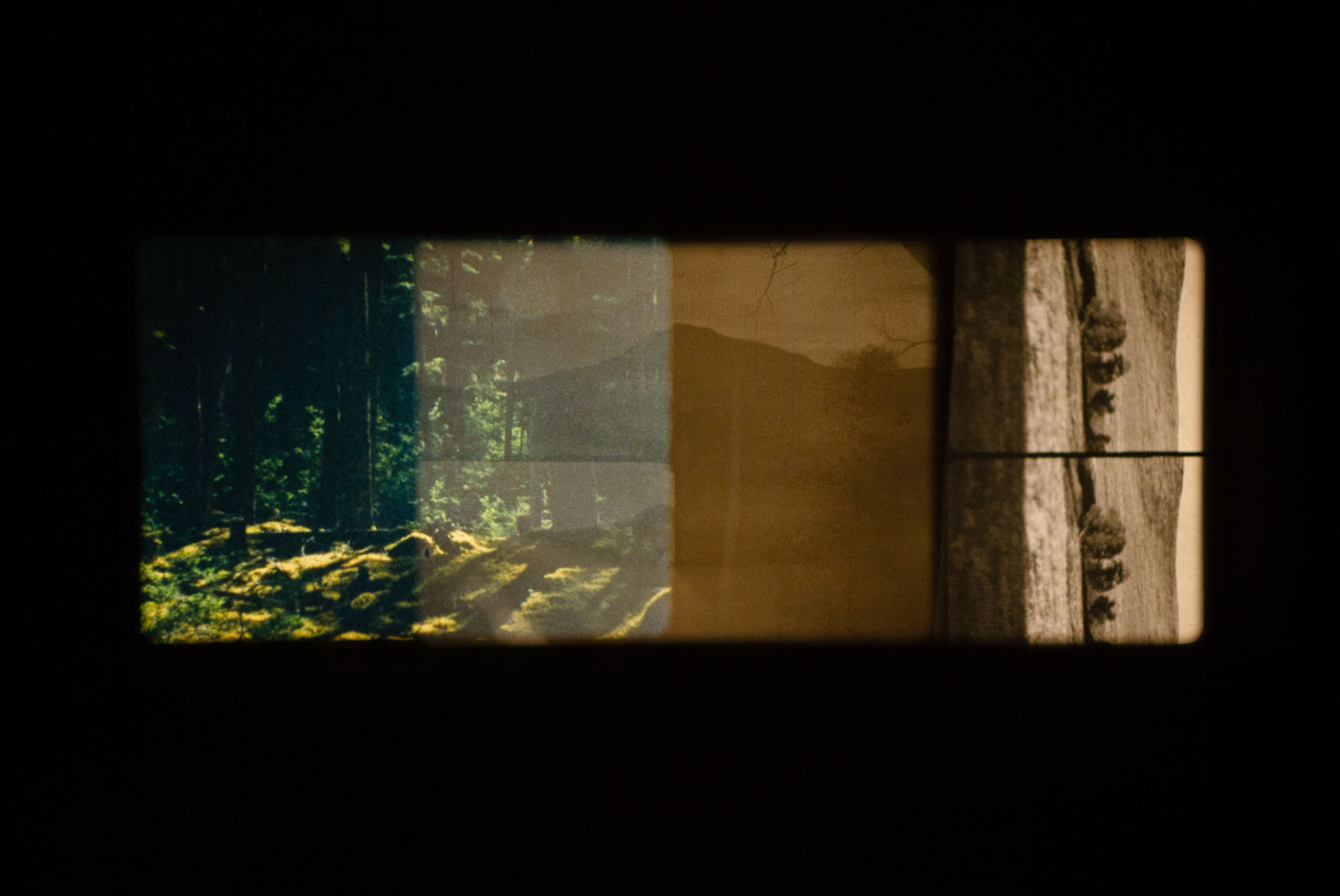
Jiayi Chen, As a Tree Walks to its Forest (2025), frame enlargement. Courtesy of Film at Lincoln Center.
Jiayi Chen expands exposure and sight through her three-channel expanded cinema piece titled As a Tree Walks to its Forest. Projected on double unsplit 8mm and 16mm hand-processed film, Chen puts the viewer in the eponymous outdoor setting. Inspired by modernist Nan Shepherd’s nature memoir The Living Mountain, Chen foregrounds the beautiful features – river, trees, mountains, leaves, and woodchips – that give “The Great Outdoors” its namesake in her three channels. Her superimpositions of the forest’s locations unite the eye-popping attractions that formulate perspective and identity in the forest’s geographic positioning. The openness in the woods gives one the freedom to explore without parameters. Similar to Chen’s adventurous trek on location, the layout of her cinematography externalizes memory and turns it into film. Chen makes the flashback literal as she uses that effect to travel back and forth across the mountain and provides a fresh approach to dreaming beyond the sky.
Review by Edward Frumkin
Disclaimer: This page is for your personal use only. It is not to be duplicated, shared, published or republished in whole or in part, in any manner or form, without the explicit permission of the publisher, author, and copyright holder(s) of the images.