
Loading cart contents...
NYFF63 CURRENTS: Mare’s Nest
Courtesy of Film at Lincoln Center
Ben Rivers’ latest film Mare’s Nest (2025) is set at the brink of a new dawn. In a world rid of adults, Moon, a child with the spirit of a lone, experienced traveller, pilgrimages through an uninhabited landscape, lapsing in and out of the present tense, and sometimes, even language itself. In this perhaps post-apocalypse, perhaps primordial, but more fittingly post/pre-everything world, in a folding and zigzagging universe of majestic landscapes and sparsely sprinkled communities formulated by children and children only, Moon’s voyage drifts between solitude and collectivity, recalling Rivers’ earlier collaboration with Ben Russell, A Spell to Ward Off the Darkness (2013), but Mare’s Nest is uniquely and eschatologically aligned with science fiction. Doomsday is no longer just a figurative sentiment but atmospheric reality, which makes it almost a relief to ponder the aftermath and our own riddance from the earth. The film is predominantly, and aura-ly, a story of the future and the past that only alludes to the present implicitly. Every now and then as the film progresses into the next sequence, marked by intertitles being chalked onto a blackboard by Moon, we in the split second of waiting start to wonder what past causality or witchy prophecies could have led to such an ending/beginning for the human race. Journeying through the future ruins of mankind with Moon, I was unable to pin down where Rivers actually stands–hopeful or resigned, playful or critical. While his tone was muffled, what felt decisive was his impulse to skip ahead in time: let’s move past ourselves. Let’s let the future talk back to us in our absence.
“Moon wanders into the past and is not impressed.”
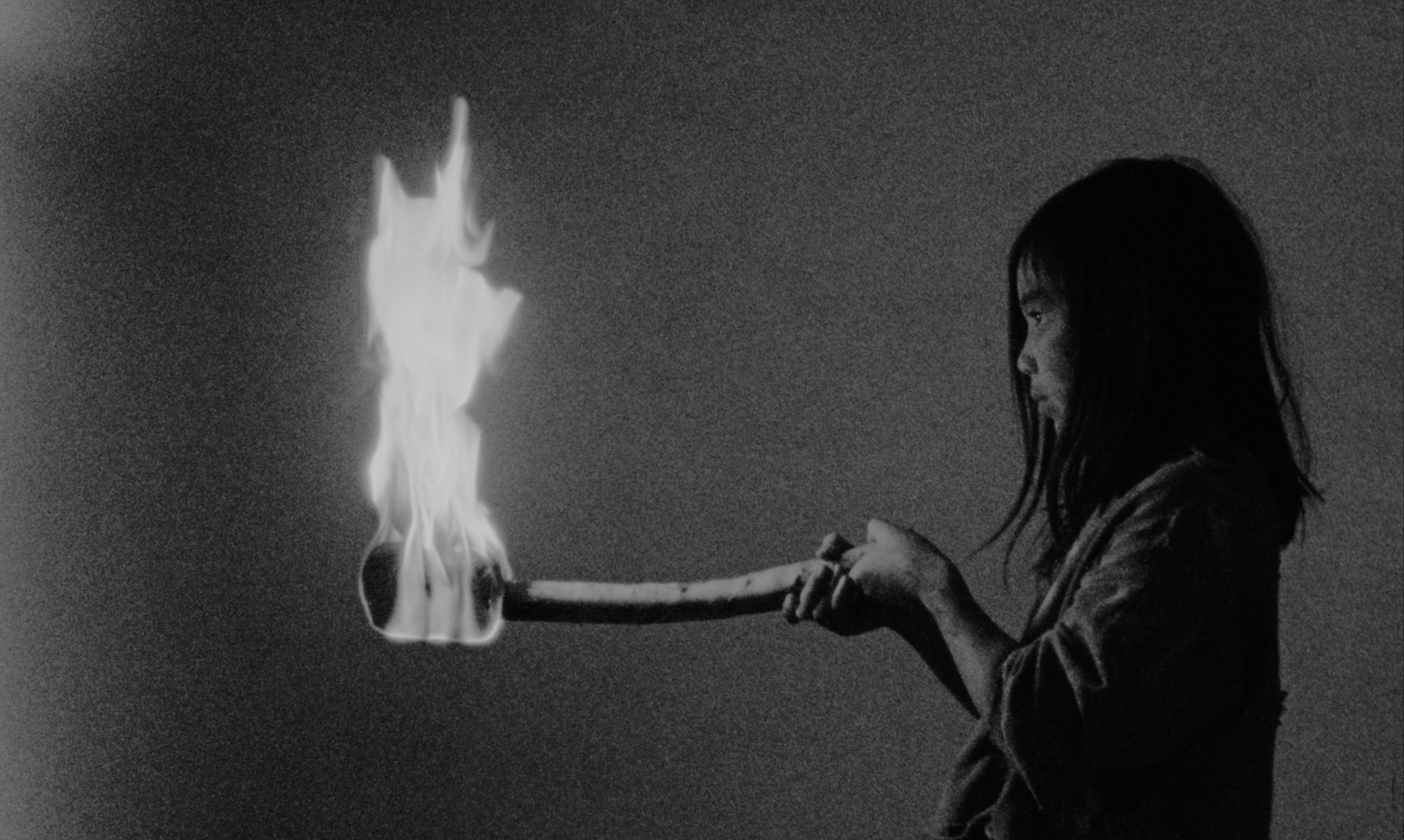
In one of the film’s more spectral sequences, Moon enters a shelter underground, a concrete structure reminiscent of nuclear bunkers—or, more humorously, homemade Cold War shelters—or, less referentially, simply a place that looks like it deals with sewage or something underground. Lit by a torch and shot in black and white, the sequence documents Moon’s encounter with fossils of the past: adults frozen in time. One audience member at the screening mistook this sequence as being composed of photographs (before Rivers explained that it was just actors being very, very still). I find it to be a testament to the visual quality of the film footage—grainy, noisy, and almost alien. It’s almost as if Moon is flipping through an old album of unrecognizable figures dressed in costumes. The adults, expressions still vivid, were obviously in the middle of something right before they were frozen in time, but now they can only be examined with an foreign eye from their future who can no longer interpret what their gestures or expressions mean. Meanings and meaningfulness are both lost to time—this is our own kind of horror: that we too will be forgotten, insignificant as cosmic dust.
Courtesy of Film at Lincoln Center
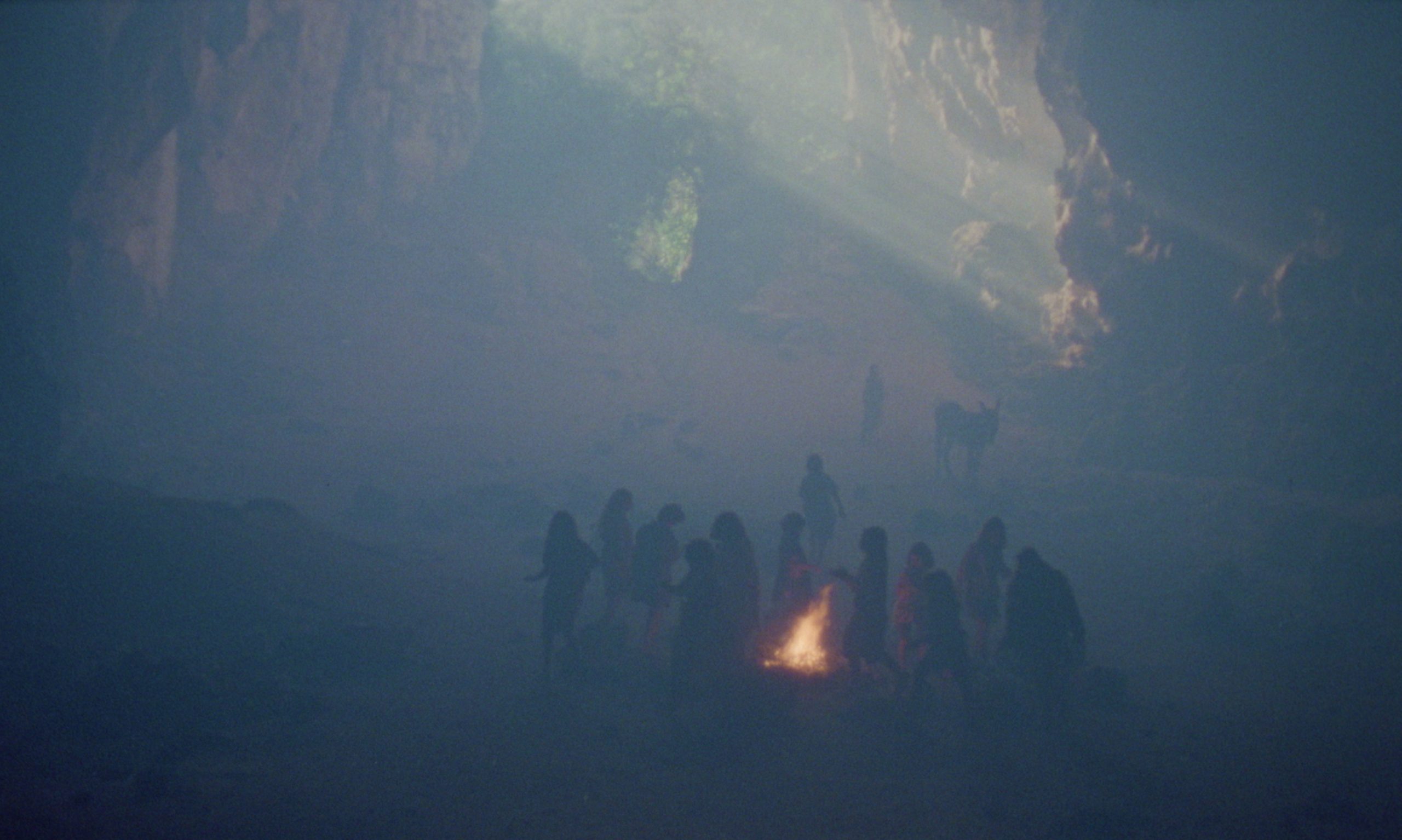
If the world ends twice—first materially, then linguistically—Mare’s Nest lingers in the second death. In a sequence titled “The Word for Snow,” a Don DeLillo play the film is based on, Moon arrives at a hut battered by wind and snow. Inside dwells a scholar, a “theologian of lost things,” and her translator. In DeLillo’s vision, the future world is depleted by climate change and children will no longer play with snow itself, but rather, the word for snow. Here in Rivers’ interpretation, the scene carries the affect of a solemn rehearsal. Recital-like and occasionally stiff, it hovers between performance and ritual. As the dialogue deepens, Moon’s search for causality dissolves under the scholar’s (ir)responsiveness. The scholar, already retreated from the world and abandoned her life’s work investigating the “final moments in a person’s life, or in the life of the planet,” communicates in Old Church Slavonic through her translator, who then renders it into English. However, to our ears, all three speak English, albeit with missing words or reinterpreted intentions. A literal loss in “translation,” a maze created by speech alone, the back-and-forth collapses into a rite of nothingness. Perhaps that is why, in one of the earlier sequences, three sisters whispered to each other:
“Speaking is so sad.”
“Such a false way of forgetting ourselves!”
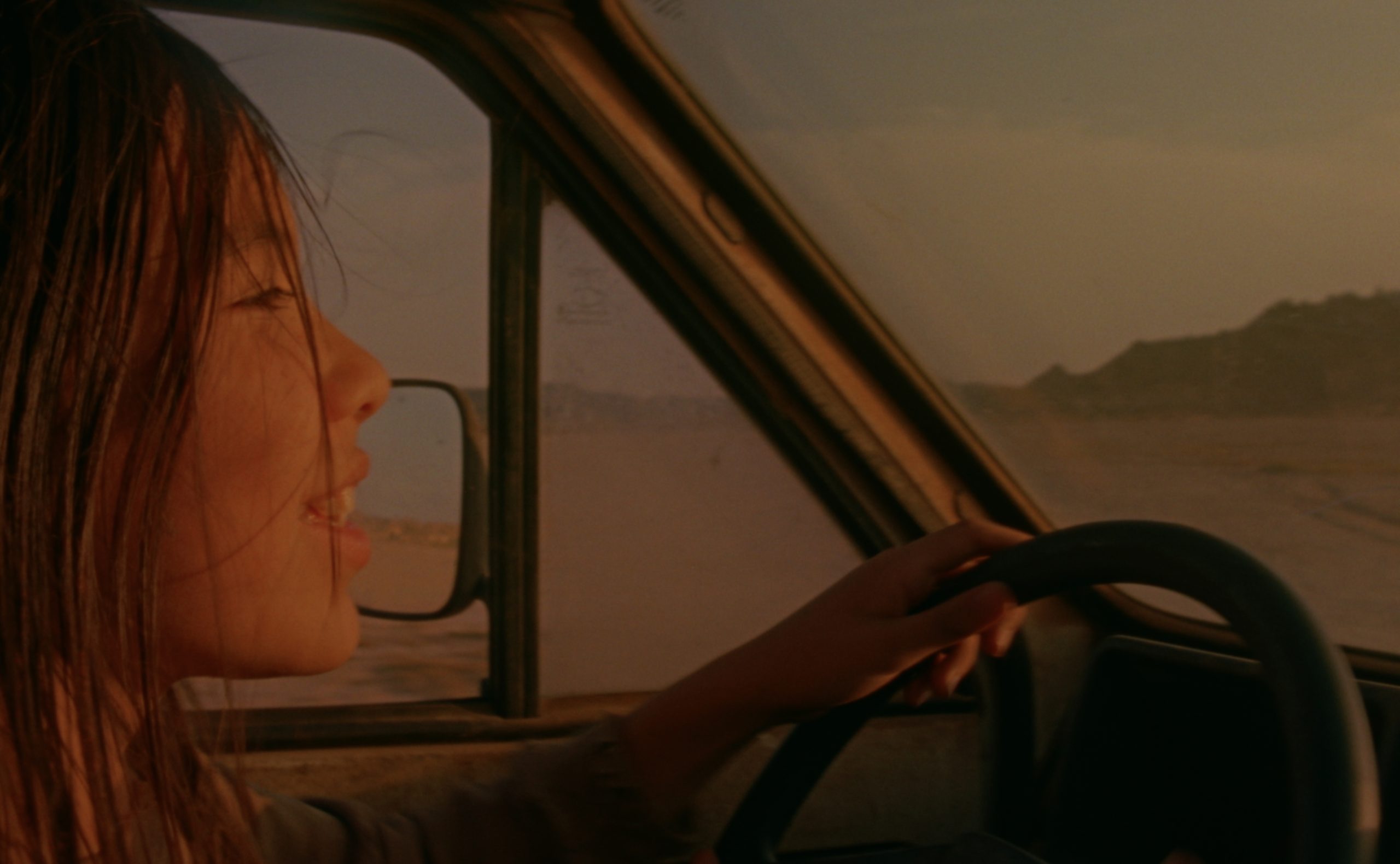
A concern for meaning runs throughout the film, anchored by a deliberate treatment of language. Opening with a car crash, the film moves into a long take where Moon goes on to recount the beginning of life on Earth to a turtle. In this almost literal big bang, we glide through the genesis of life, all the way from molecules to the brief, fleeting eons of terrestrial existence via an Encyclopedic prologue, allegorically co-starring a turtle whose longevity might insinuate the history spoken was a lived one, and possibly, a wordless one. In a mixture of Carl Sagan-esque wonder coupled with a rather plain mise-en-scène provided by a dirt road, we are suddenly confronted by a past that is being reduced to words and words only. However, amidst this language of archive, residue, and consolation, Mare’s Nest, an old saying describing a confused or unexplainable situation through an non-existent object, hints at the possibility of a more generative absence (of language, of meaning, of certainty).
Courtesy of Film at Lincoln Center
Mare’s Nest ends as it begins, in a hazy past/future where meaning has evaporated and what’s worth remembering never explained. At least we will still remember the epic landscapes from the Monegros desert in northern Spain, or the minotaur played by a misunderstood child roaming through the Lithica labyrinth, where all myth is but child’s play and where “we have myth to protect us when history goes mad,” according to the translator in that wind-battered hut.
Mare’s Nest made its North American premiere at the 63rd New York Film Festival’s Currents section.
Review by Yanxiu Luo
Disclaimer: This page is for your personal use only. It is not to be duplicated, shared, published or republished in whole or in part, in any manner or form, without the explicit permission of the publisher, author, and copyright holder(s) of the images.